
Overview
Product: Scaling It
Business model: AI-enabled SaaS and hybrid AI-professional services
Target market: Australian very small businesses (1–20 employees)
Lifecycle stage: Product management and improvement
Goal: Simplify technology adoption and business system improvement
Solution: Integrated business analysis, project management, and continuous improvement platform.
Technology: OpenAI, Supabase, GitHub, Stripe, and supporting integrations.
Project duration: Six months from commencement to launch.
Scaling It is an independently conceived and developed digital product designed to make technology adoption and business systems improvement more accessible, practical, and affordable for very small Australian businesses.
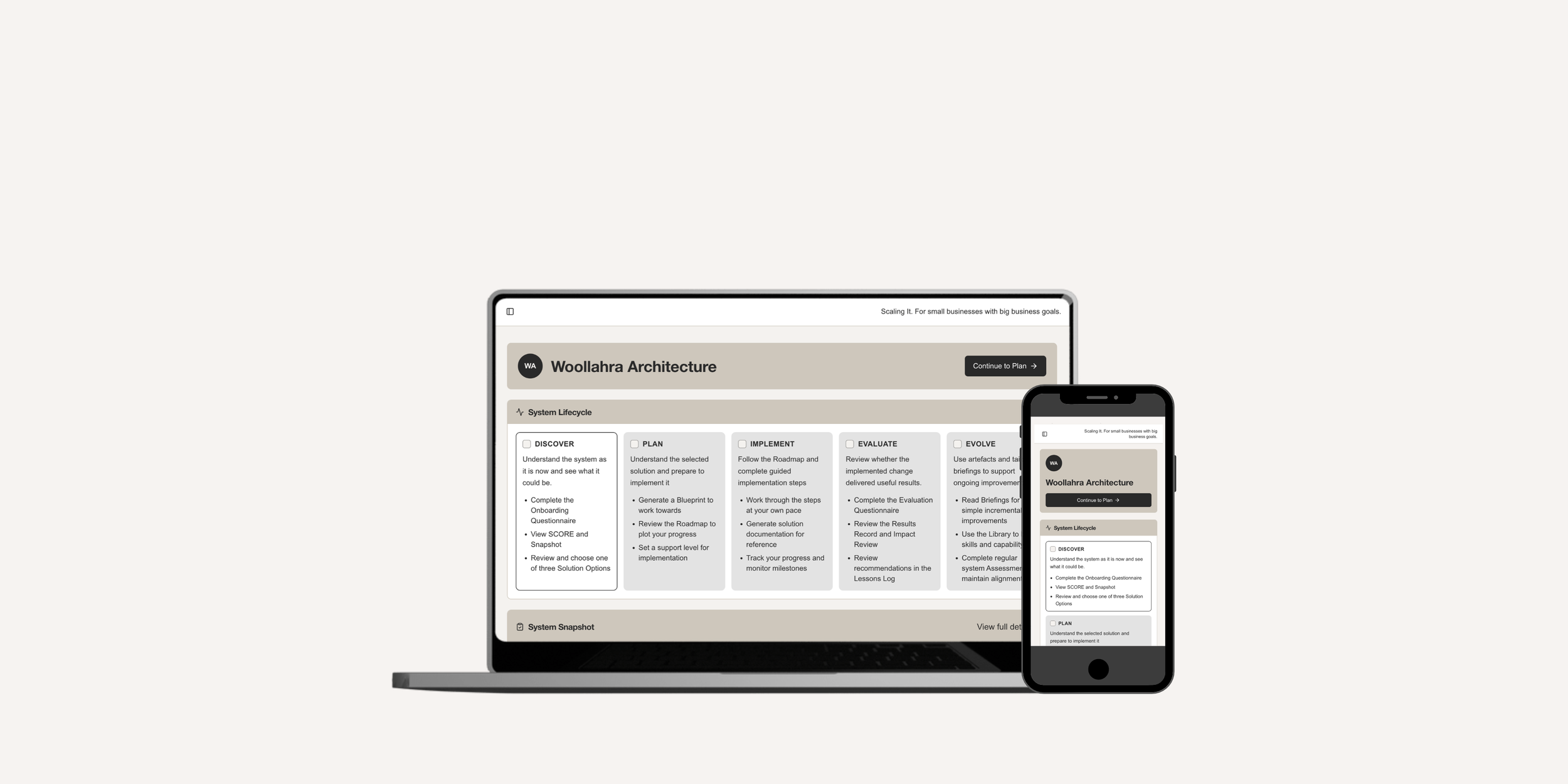
The platform translates established principles of business analysis, systems architecture, project management, and organisational change into a guided, five-stage journey: Discover, Plan, Implement, Evaluate, and Evolve. Structured assessments, capability scoring, AI-assisted recommendations, and implementation guidance help businesses identify opportunities, evaluate solutions, and make informed improvements across their systems.
The project encompasses product strategy, business and solution architecture, assessment design, information modelling, UX/UI design, AI integration, application development, testing and commercialisation. Following initial development, the product has progressed into ongoing management, evaluation, and iterative improvement.
Analysis
In April 2026, 42% of Australian SMEs reported having introduced AI into their business activities
Source: NAB, 2026.
Strategy
“Business leaders today face an unprecedented challenge: moving beyond pilots to truly integrating AI into the heart of their organisations.” - Deloitte, January 2026.
Very small businesses increasingly depend on digital technologies to manage operations, deliver services, and engage customers. Yet adopting new applications, integrating AI, and automating individual tasks does not necessarily produce a more effective business system.
Research available at the time indicated that adoption of AI among enterprises globally was primarily at a surface level (Deloitte, 2026), while among SME’s in Australia, only 42% had adopted it into daily business activities (NAB, 2026), with uptake highly varied across industries, leaving a vast amount of potential and productivity in the Australian economy remaining untapped (Deloitte, 2025).
Limited resources, fragmented information, competing priorities, and the complexity of available solutions can make sustained improvement difficult. Scaling It was conceived to address this gap by making structured, context-sensitive systems improvement accessible to businesses without dedicated IT or transformation teams.
Best Practice: What makes system improvement effective?
Effective technology adoption and system improvement begins with understanding how a business operates, what it is trying to achieve, and how its people, processes, information, and technology work together.
Solutions should be proportionate to the business's capabilities and resources, evaluated against meaningful outcomes, and supported by practical implementation guidance. Technology adoption is one possible pathway to improvement, rather than the objective itself.
Product Framework
Scaling It was designed around three principles: Considered Context, Practical Pathways, and Refined Recommendations. These principles informed a modular assessment framework, contextual solution recommendations, staged implementation guidance, and continuous evaluation.
The product combines established management disciplines with AI-assisted analysis to make sophisticated systems improvement methods practical for very small businesses, while preserving business ownership of decisions and implementation.
Solution Design
Platform Architecture
Scaling It was designed as an integrated business systems improvement platform, combining structured assessment, contextual analysis, solution planning, implementation guidance, and continuous improvement in a single application. The product architecture incorporates twelve capability modules organised into three interconnected areas: Architecture, Orchestration, and Performance. These provide a consistent framework for examining how a business manages information, uses technology, coordinates activities, and delivers value. The application combines structured assessment and evidence-based scoring with AI-assisted analysis and recommendations. Its five-stage lifecycle guides users from understanding their current system through planning, implementation, evaluation, and ongoing development, while preserving business ownership of decisions.
Analysis & Decision Support
AI-assisted analysis helps translate assessment findings into contextual recommendations and three alternative solution pathways, considering the business's objectives, existing capabilities, resources, and constraints.
A selected solution is developed into a Blueprint and Roadmap, with implementation milestones and supporting guidance. The design prioritises proportionate, achievable changes rather than prescribing technology adoption as an end in itself.
Assessment & System Intelligence
Structured questionnaires establish business context, objectives, current capabilities, and opportunities for improvement. A modular assessment framework allows businesses to investigate individual areas or undertake a broader system review.
The SCORE methodology evaluates recognised practices and their suitability to business circumstances, while system snapshots and visual models communicate findings in an accessible format.
Project & System Management
The platform supports implementation through guided activities, progress monitoring, documentation, and access to professional assistance where required.
Evaluation tools compare implemented changes against intended outcomes, while maintained records, periodic assessments, and curated resources support continuing improvement. This creates continuity between initial decisions, implementation, measured results, and future development.
Product Experience
Starter Quiz
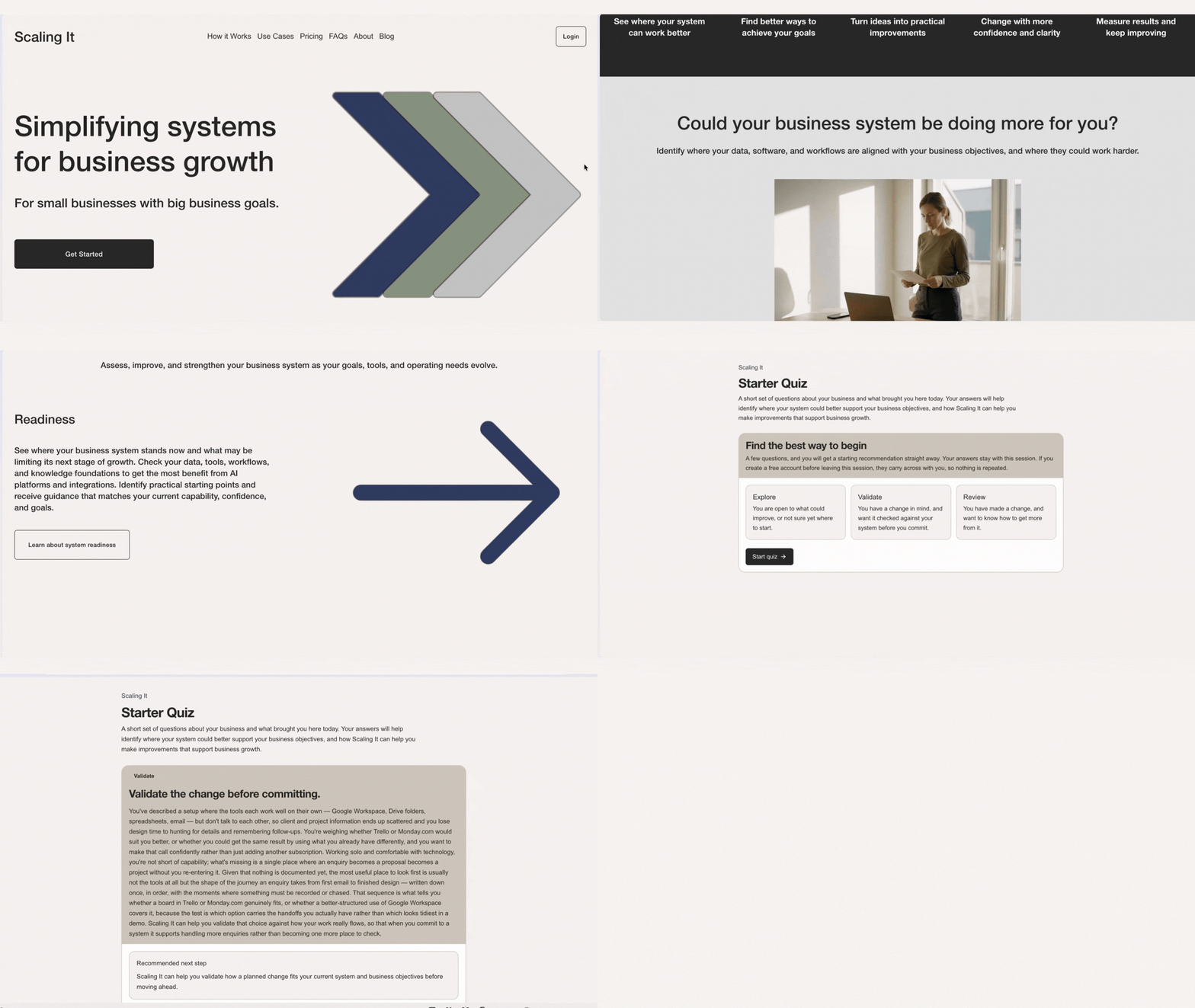
The Starter Quiz provides a simple, accessible introduction to Scaling It without requiring an account. Through ten short questions, it explores the business's current circumstances, goals, challenges, and priorities to identify a suitable starting point for improvement.
Using AI to interpret the responses, the quiz generates a personalised summary that helps users understand where their business systems might benefit from attention. Whether they are exploring opportunities, considering a particular change, or evaluating a recent improvement, users receive practical initial guidance and a recommended next step. The experience demonstrates how Scaling It translates business context into relevant, actionable insights without requiring technical expertise.
Free Plan
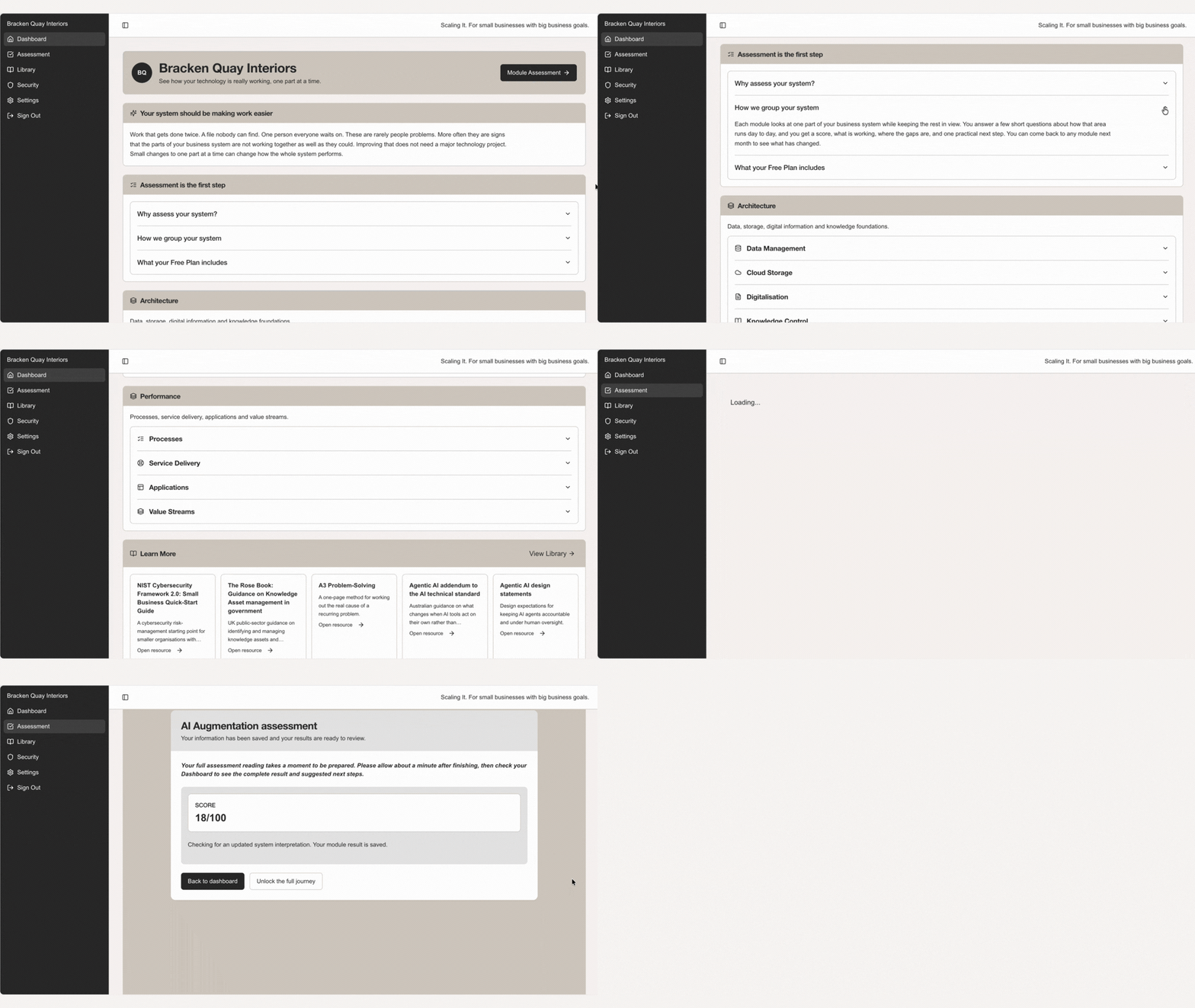
The Free Plan provides an accessible entry point for businesses wanting to understand and improve their existing systems at their own pace. Users can undertake individual assessments across twelve modules covering Architecture, Orchestration, and Performance, from data management and digitalisation to AI adoption, business processes, and applications.
Each assessment examines a specific capability and generates personalised insights, a module SCORE, a Snapshot, and practical improvement actions. Users can assess each module once per calendar month, progressively building a more comprehensive understanding of their business systems over time. The experience introduces Scaling It's structured assessment methodology while giving users useful, actionable guidance without requiring a paid subscription.
Solution Discovery
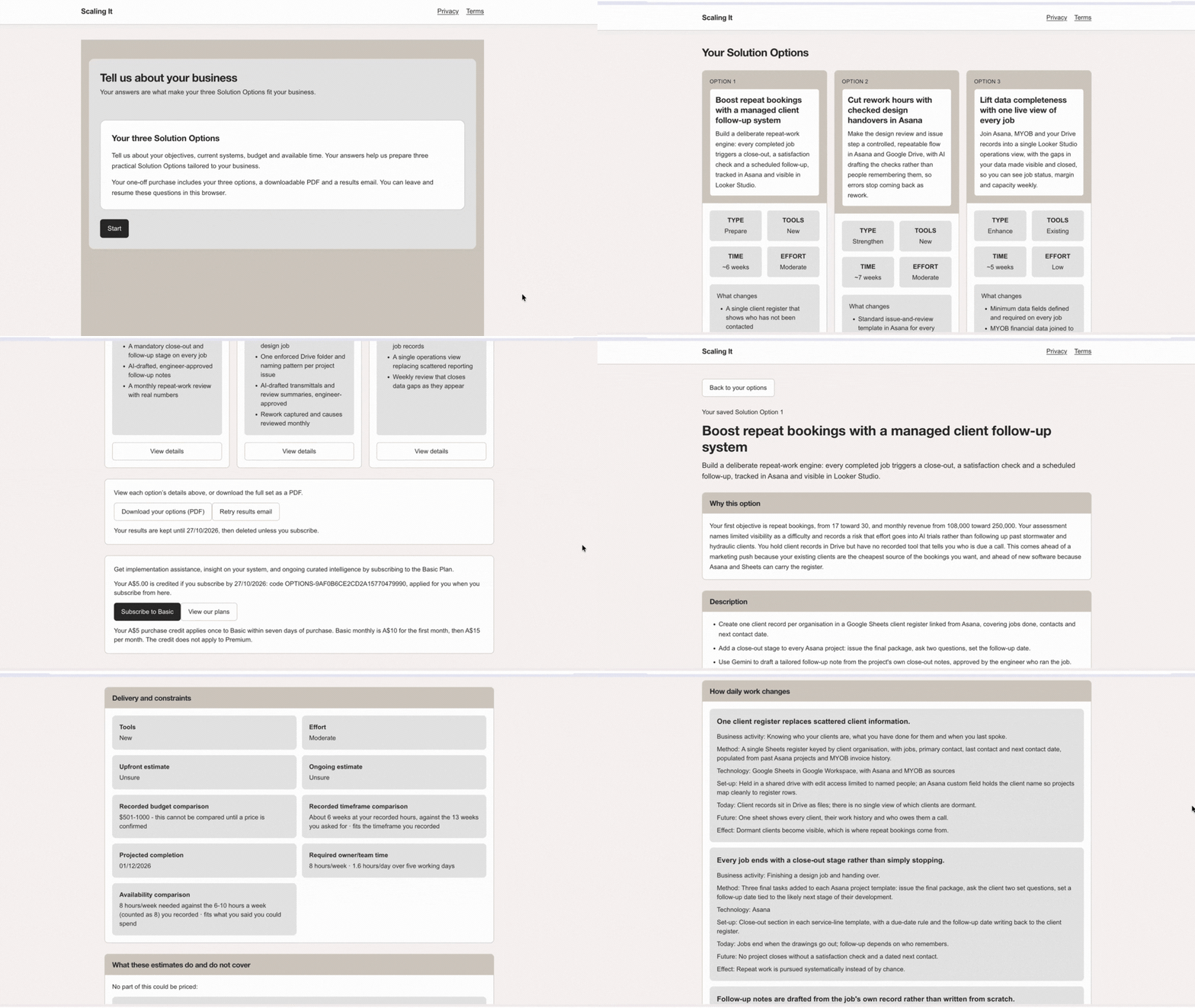
Solution Discovery offers a standalone, low-cost way for businesses to explore potential improvements without committing to a subscription. Through a structured questionnaire, users describe their business, existing systems, challenges, objectives, and constraints, providing the context needed to develop relevant recommendations.
Scaling It analyses this information to generate three tailored Solution Options, each presenting a potential approach to the business's identified needs. The recommendations provide a basis for comparing alternatives and making informed decisions about the next steps. Results are delivered through a PDF report, email, and private access link. The experience demonstrates the product's ability to turn complex business information into considered, practical recommendations through AI-assisted analysis.
Basic Plan
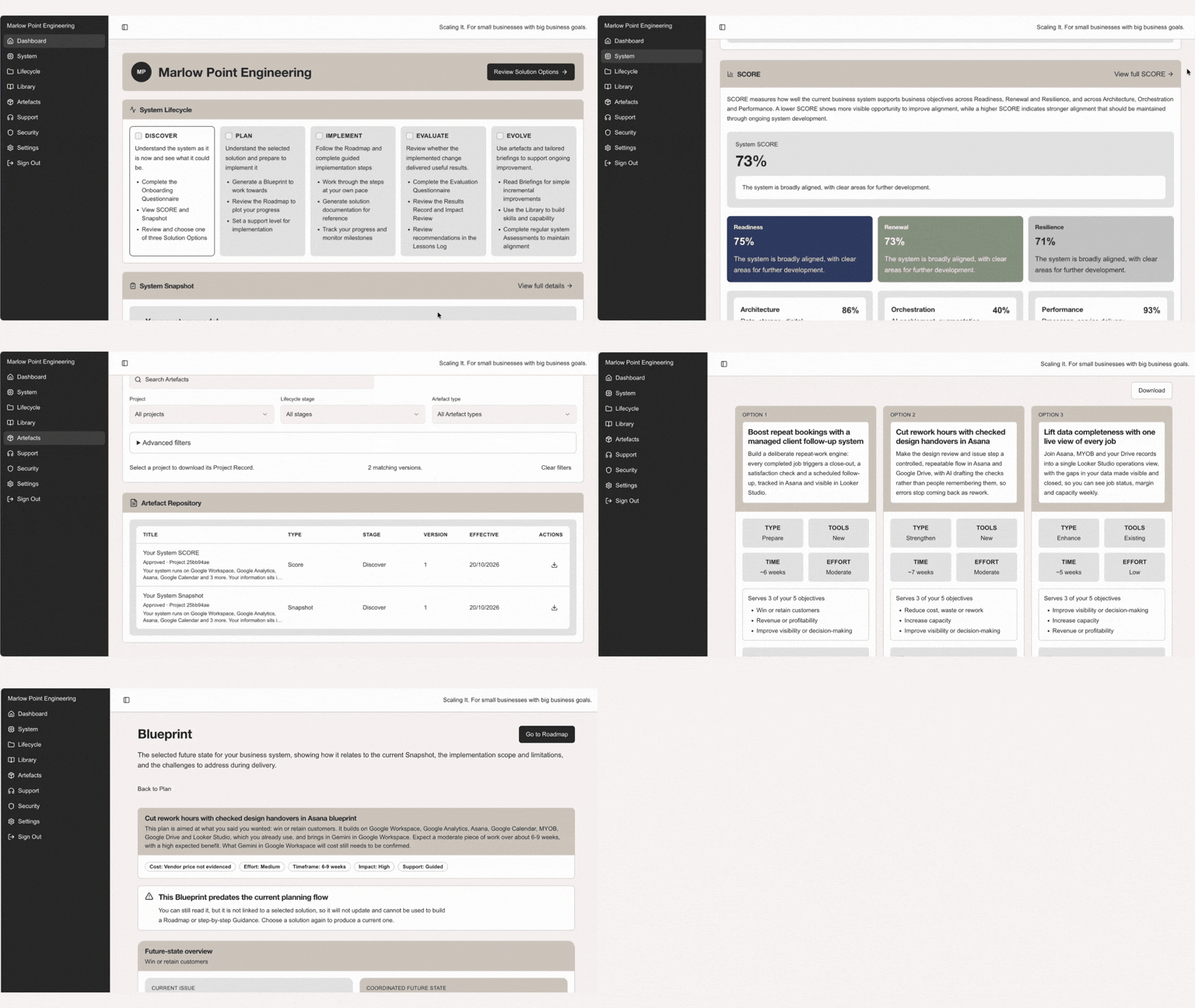
The Basic Plan provides access to Scaling It's complete business systems improvement journey, from initial discovery through planning, implementation, evaluation, and ongoing improvement. Following a comprehensive onboarding assessment, users receive a System Snapshot and SCORE dashboard assessing their systems through three lenses: Readiness, Renewal, and Resilience. These insights help identify strengths, weaknesses, opportunities, and priorities across the interconnected areas of Architecture, Orchestration, and Performance.
From this foundation, users can explore three tailored Solution Options and develop their preferred approach into a Blueprint, Roadmap, and Step-by-Step Guidance for implementation. Progress tracking, structured evaluation, reusable artifacts, and regular system reviews support the full improvement lifecycle. The experience combines business analysis, AI-assisted recommendations, and practical project guidance into an integrated workspace, empowering small businesses to plan, implement, and evaluate improvements through an assisted DIY approach.
Results
Explore, Validate and Review were designed to give small businesses three different starting points, recognising that not everyone approaches system improvement with the same needs or circumstances. Some businesses want to discover opportunities, others have an idea they would like to investigate, while others have already introduced a change and want to understand how well it is working.
Each intent follows the same underlying approach: understanding the business, its objectives, existing technology, information, processes and ways of working. The onboarding questionnaire, personalised results, and three Solution Options are then shaped around the user's starting point. The intention is to make the recommendations relevant and actionable, rather than applying the same generic advice to every business.
Validate
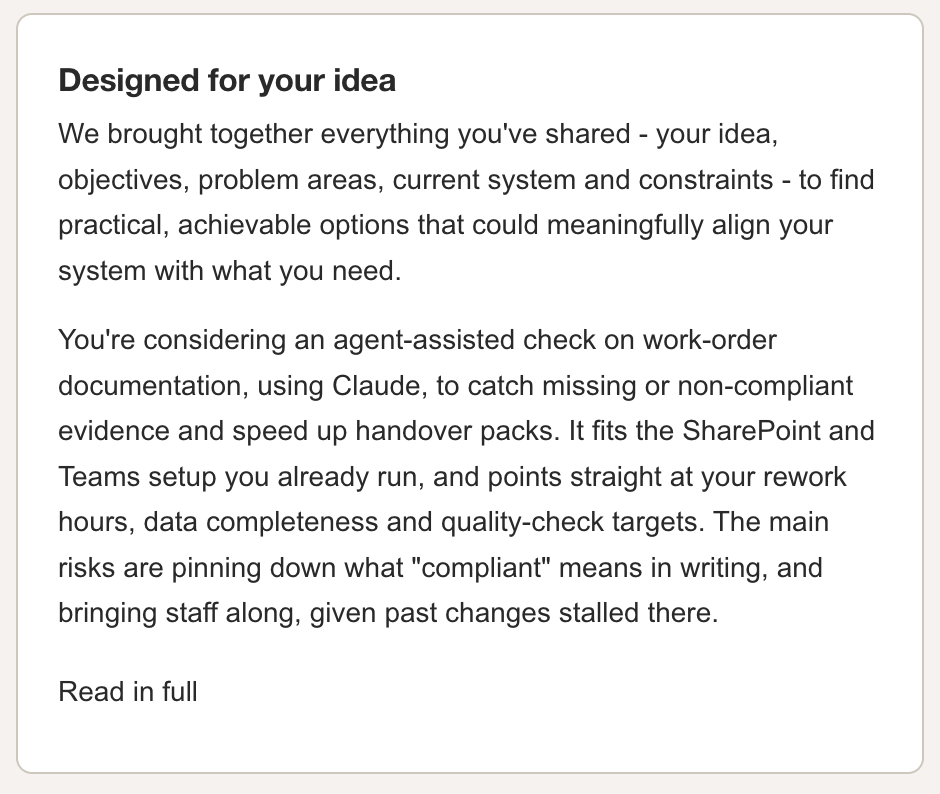
Validate is designed for businesses that already have an idea, whether introducing new technology, improving a process, adopting AI, or changing how existing systems work together. Alongside the broader business assessment, the onboarding questionnaire collects information about the proposed idea, its intended outcomes, assumptions, and practical requirements.
The results consider how the idea fits the existing system, where it may create value, and what dependencies, gaps, or risks could affect its success. The three Solution Options are designed to help the user make an informed decision. They may present different approaches to implementing the idea, a more suitable alternative, or preparatory measures needed before proceeding. The objective is to test the idea constructively and improve on it.
Explore
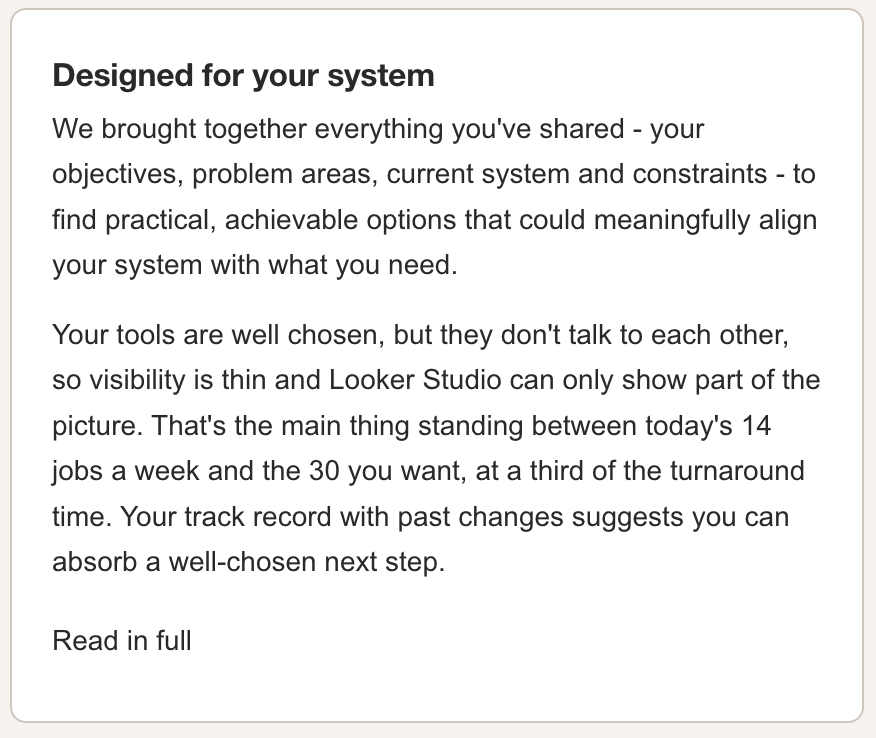
Explore is designed for businesses that recognise opportunities to improve but are unsure where to begin. The onboarding questionnaire establishes a broad understanding of the business system, its strengths, challenges, constraints and objectives, without requiring the user to identify a particular problem or preferred solution in advance.
The results bring these findings together to identify meaningful opportunities for better system alignment. Three distinct Solution Options are developed from the assessment, each proposing a practical way forward, explaining why it matters, what would change and how it could support the business's objectives. The emphasis is on discovering possibilities the owner may not previously have considered.
Review
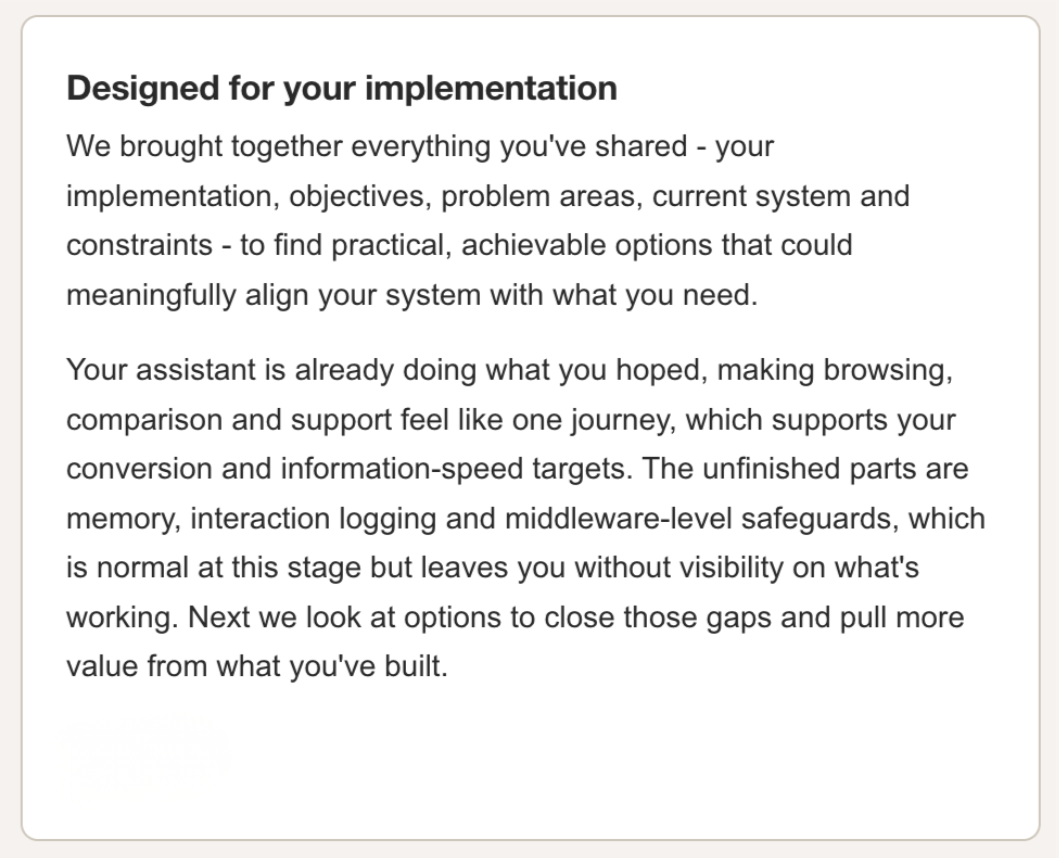
Review helps businesses that have recently implemented a change to understand its effectiveness and identify what they can do to improve or optimise it. The onboarding questionnaire considers what was introduced, what the business intended to achieve, how the implementation is performing and which issues or unfinished elements remain, alongside the broader assessment.
The results examine how the implementation fits into the business system, recognising what is working while identifying limitations, risks, and opportunities to build on the investment. The three Solution Options focus on practical next steps, such as improving adoption, strengthening safeguards, resolving integration gaps or extending existing capabilities. Review aims to help the business obtain greater value from what it has already implemented.
Product Management
Following its initial development and launch, Scaling It entered an ongoing product management and improvement lifecycle. Development priorities are informed by functional testing, simulated business scenarios, technical performance, usability reviews, and emerging opportunities in AI and business systems technology.
Release Management
Product development is managed through GitHub, with documented issues, controlled code changes, pull requests, and testing prior to deployment. Version control and release procedures support traceability, application stability, and the protection of existing functionality.
Quality & Evaluation
Testing incorporates functional validation, integration checks, security considerations, and end-to-end user journeys across different business scenarios. Identified issues are investigated and addressed through iterative improvements, with particular attention to reliability, accessibility, and the quality of AI-assisted outputs.
Continuous Improvement
Ongoing development focuses on refining the user experience, improving assessment and recommendation quality, and adapting the platform to advances in technology. Product priorities are evaluated against user needs, practical business value, technical feasibility, and available resources, with customer feedback informing future improvements as it becomes available.
Summary & References
Scaling It demonstrates the end-to-end development of an independently conceived commercial software product, from identifying a market opportunity and defining a product strategy through solution architecture, application development, testing, launch, and ongoing management.
The project brings together business analysis, systems architecture, AI integration, UX/UI design, project management, and continuous improvement to deliver a practical platform for very small Australian businesses.
Beyond its technical implementation, Scaling It represents an ongoing commitment to making sophisticated business improvement methods more accessible, supporting informed decisions, sustainable technology adoption, and better-performing business systems.
Deloitte (2026). State of AI in the Enterprise 2025: The Untapped Edge. Deloitte AI Institute, January 2026.
Deloitte Access Economics (2025). The AI Edge for SMBs. Deloitte Access Economics, research produced for Amazon, November 2025.
NAB Behavioural & Industry Economics (2026). Embracing AI: Adoption & Key Opportunities Identified by SMEs. NAB SME Business Insights, April 2026.