
Overview
Client: Fashion reseller
Structure/size: Sole trader
Goal: Managing market growth through expansion with current technologies
Solution: AI-driven inbound marketing, CRM, and enhanced analytics.
Stack: OpenAI, Zoho CRM, Google Looker Studio, and Zapier.
This project builds on a 2024 marketing program for a fashion reseller where the client has decided in 2025 to expand into sustainable activewear and wants to adapt and streamline their marketing efforts. The solution involved an automated marketing system comprised of a Zoho CRM tailored to the business circumstances and goals, an inbound marketing campaign across social media, email, and blog content, and Google Looker Dashboard, partially automated with the OpenAI API and Zapier.
Analysis
Challenge
The 2024 fashion resale marketing plan identified strong creative and strategic potential but revealed structural limitations in execution. While objectives for brand awareness, customer retention, and sales growth were clearly defined, marketing activities relied heavily on manual coordination across email, social, SEO, and content channels. This created inconsistency in timing, limited personalisation at scale, and constrained the business’s ability to learn from customer behaviour over time. Email engagement and repeat purchase growth, in particular, were difficult to sustain without systematic segmentation and lifecycle management. As product volume increased and customer touchpoints multiplied, the absence of an integrated CRM and analytics workflow became a strategic risk. The 2025 challenge was therefore not one of ideation, but of translation - converting an insight-rich marketing plan into an automated system capable of executing, measuring, and iteratively improving marketing performance.
Marketing Objectives

Strategy
Reports from marketing industry leaders like Adobe (2024), Salesforce (2023), Shopify (2025), and Klaviyo (2024) converge on three core shifts. Firstly, AI is now embedded across the marketing stack; secondly, value is realised through end-to-end workflows rather than isolated tools; and thirdly, competitive advantage increasingly depends on data readiness rather than model sophistication. Within fashion marketing specifically, the literature emphasises personalisation, storytelling, and responsiveness as decisive differentiators. Fashion and resale brands operate in emotionally driven, visually rich markets where customers expect relevance, curation, and dialogue rather than broadcast messaging. Industry reports highlight AI’s effectiveness in audience segmentation, dynamic content generation, lifecycle messaging, and predictive engagement, particularly when integrated with CRM and ecommerce data. At the same time, guidance consistently warns against over-automation. Trust, brand voice, and authenticity remain critical, especially in luxury and resale contexts where provenance, sustainability, and individuality shape purchase decisions. GenAI guidance for fashion further stresses three principles: (a) AI should augment creative and strategic work, not replace it, supporting copy variation, campaign testing, and content velocity while preserving human brand direction; (b) automation should be event-driven and context-aware, triggered by customer behaviour rather than rigid schedules; and (c) measurement and feedback loops are essential because AI-driven campaigns must be observable, auditable, and continuously refined through engagement and conversion data. These principles directly informed the design of the 2025 fashion resale marketing automation solution.
Solution Design
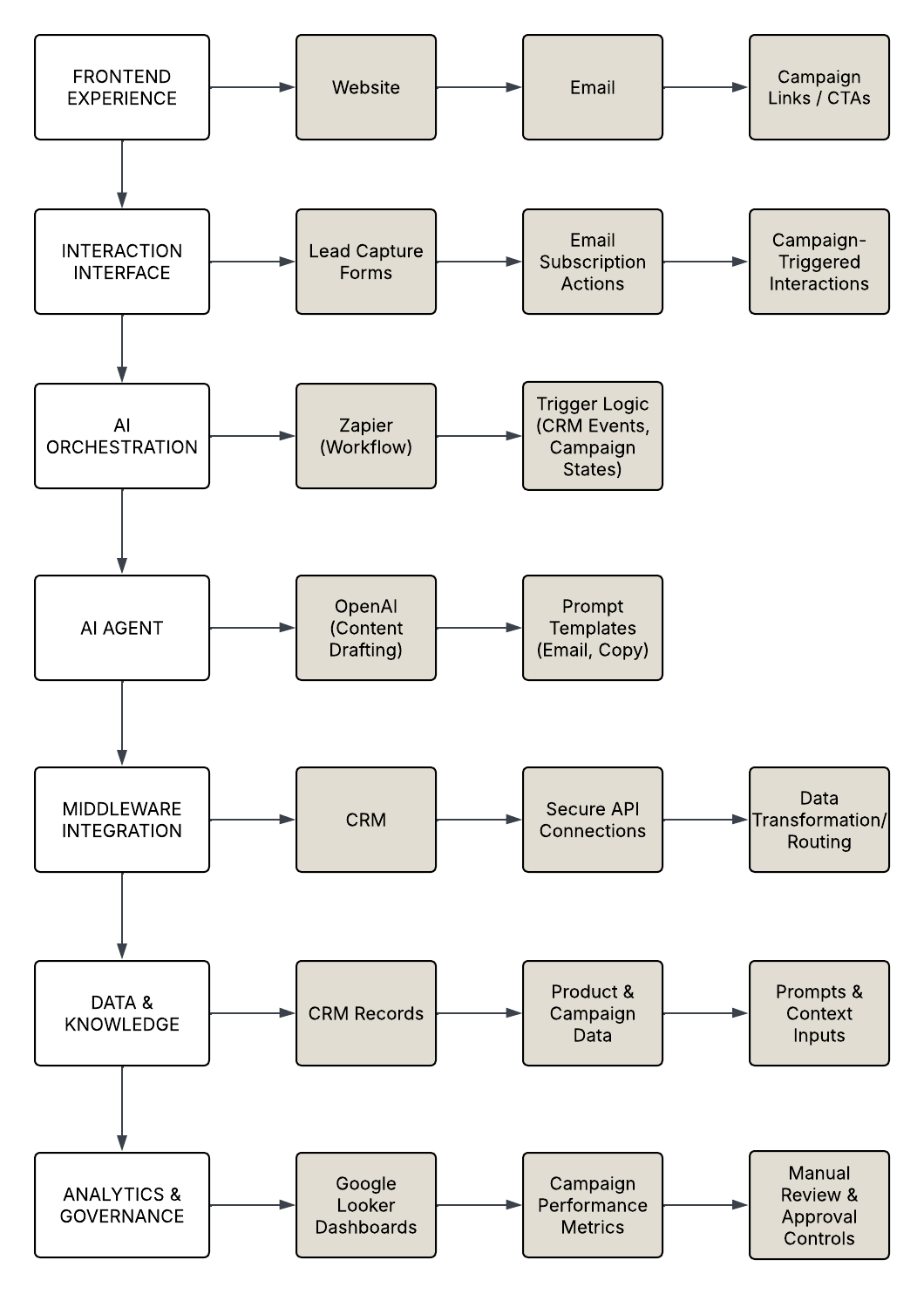
The solution design for the fashion resale marketing automation project focused on translating the strategic intent established in the 2024 marketing plan into a small, coherent, and maintainable system. Rather than introducing complex automation or advanced AI decision-making, the design emphasised consolidation, clarity of roles across systems, and repeatability of execution. The solution brought together three core elements: a CRM configured to support lifecycle-based marketing, a set of inbound and outbound campaign workflows aligned to the fashion resale context, and a consolidated analytics layer to provide visibility into performance. AI was introduced selectively, using OpenAI via Zapier to assist with content drafting at defined trigger points, while retaining human oversight. This approach ensured the system reflected the actual maturity of the business and the work undertaken, while establishing a clear architectural foundation for future expansion without overstating automation capability.
AI Automation
The 2025 fashion resale project implemented a lightweight, demonstrative AI automation to operationalise elements of the 2024 marketing strategy rather than fully automate all marketing activity. The core automation integrated Zoho CRM with Zapier and OpenAI to generate personalised outbound content at key lifecycle moments, such as initial lead capture and campaign-based engagement. OpenAI was used in a narrowly scoped role to transform structured CRM inputs (for example, customer name, acquisition source, and campaign context) into brand-aligned email copy, rather than making autonomous marketing decisions. Zapier acted as the orchestration layer, triggering OpenAI prompts from CRM events and routing generated outputs into email or campaign drafts. The primary benefit of this approach was consistency and repeatability in messaging, while preserving human oversight. This design aligned with the project’s intent to demonstrate practical AI augmentation rather than full automation, and mirrored the incremental adoption pattern established in the other marketing automation case studies.
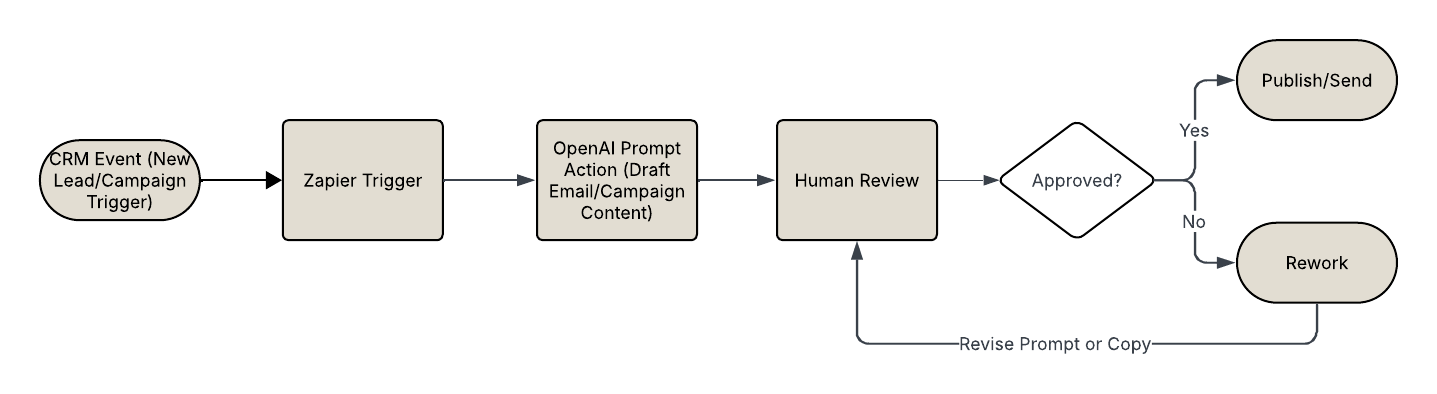
Automation Flow Diagram
Data Preparation
The solution formalised core marketing data across Zoho CRM, inbound campaigns, and analytics to support both automation and reporting. Customer, product, order, campaign, and channel data were structured to reflect the resale context, including repeat purchase behaviour and product turnover. While a full production data pipeline was not implemented, a conceptual data model was established to ensure consistency between CRM fields, campaign logic, and Looker dashboard metrics. CRM exports and campaign data were structured to support downstream analysis in Google Looker, enabling calculation of engagement, revenue, and retention indicators. This data foundation directly supports future development, including more advanced segmentation, cohort analysis, and predictive insights, while also improving general business visibility beyond marketing alone.
Data Model
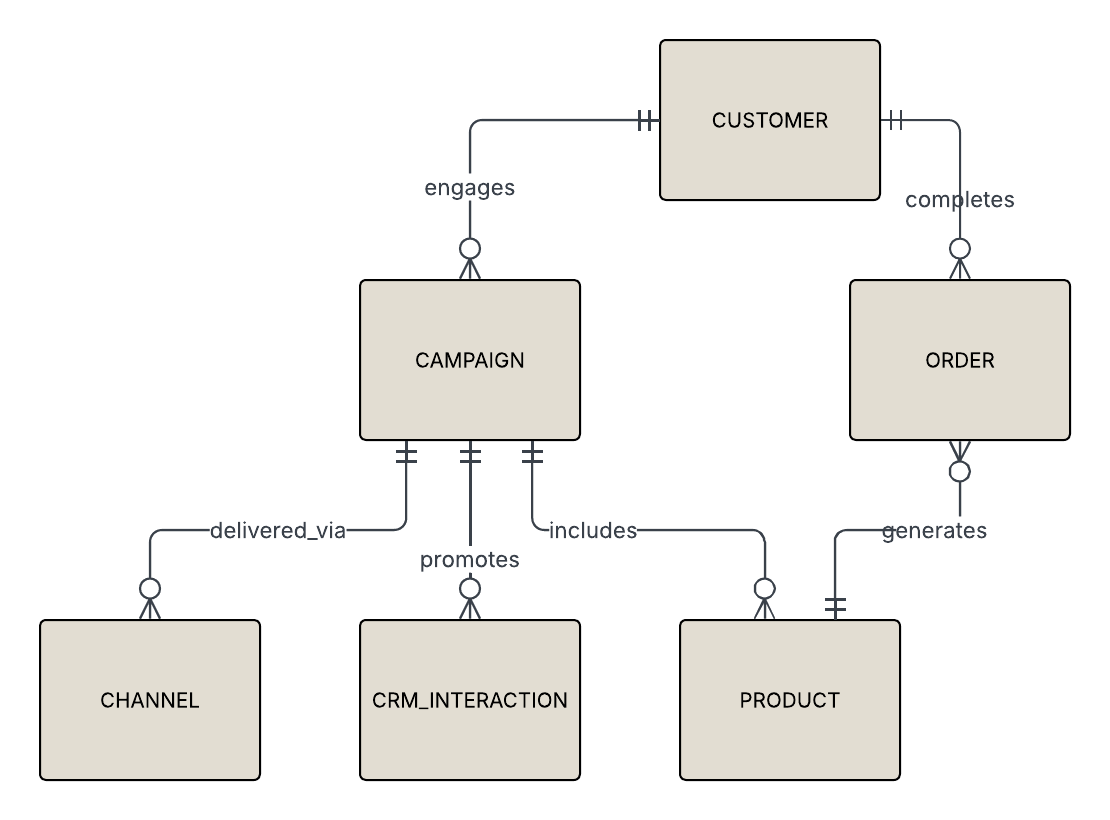
CRM, Inbound Marketing, and Dashboard.
Zoho CRM was configured to support the fashion reseller’s lifecycle-driven marketing objectives, with custom fields for acquisition source, engagement status, and repeat customer identification. Inbound marketing design focused on mapping the 2024 strategy into executable workflows, including welcome sequences, campaign-specific messaging, and re-engagement logic, without over-automation.
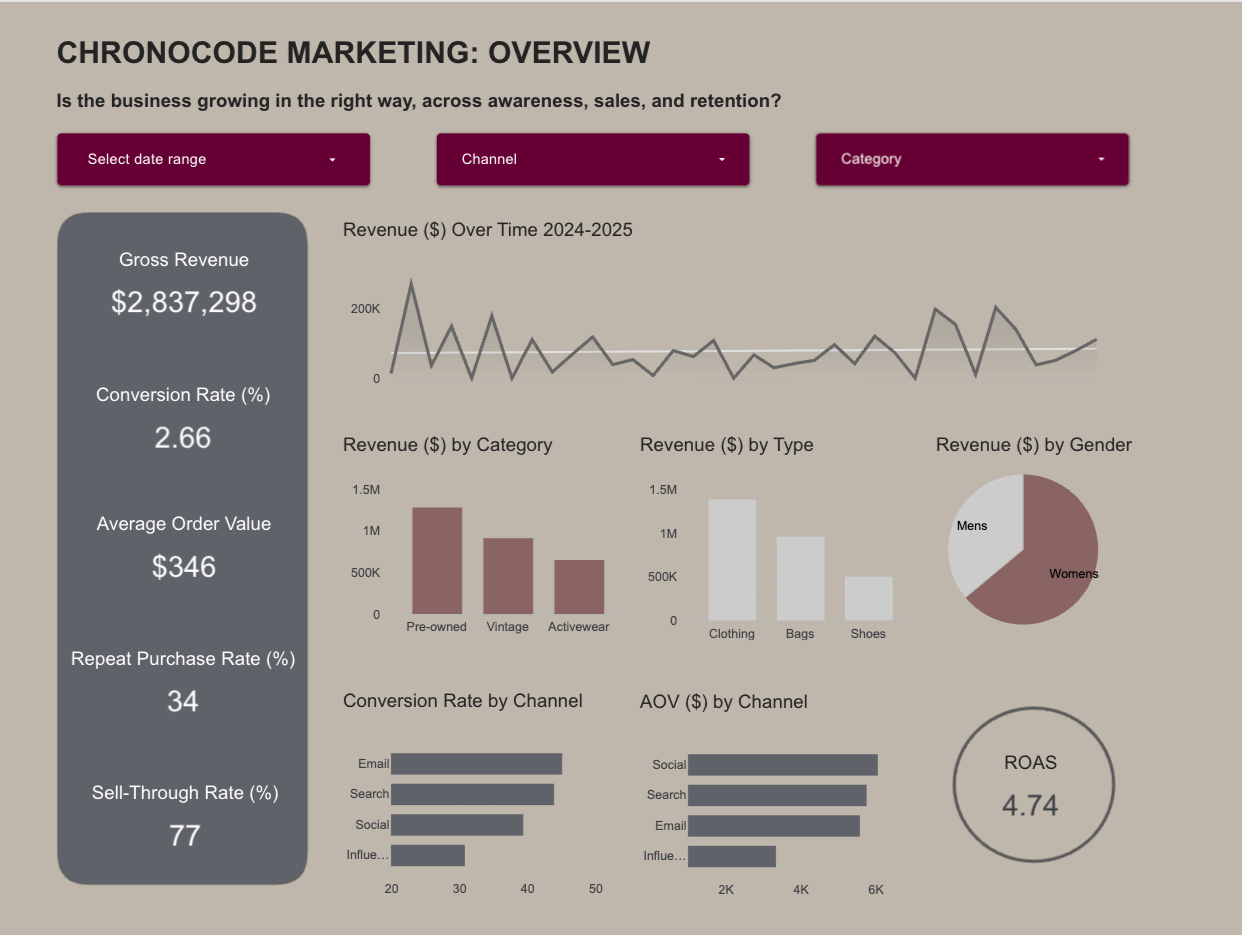
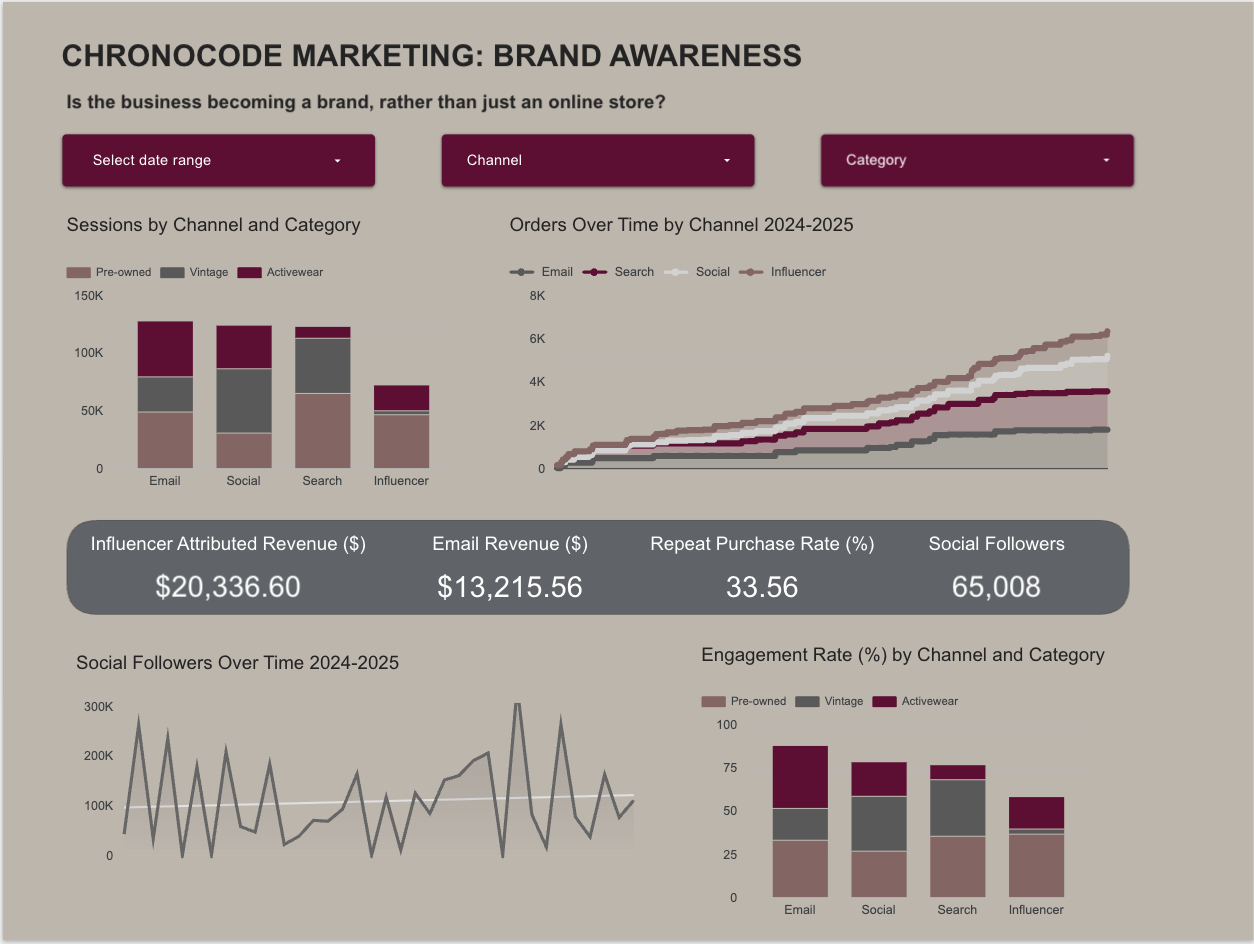
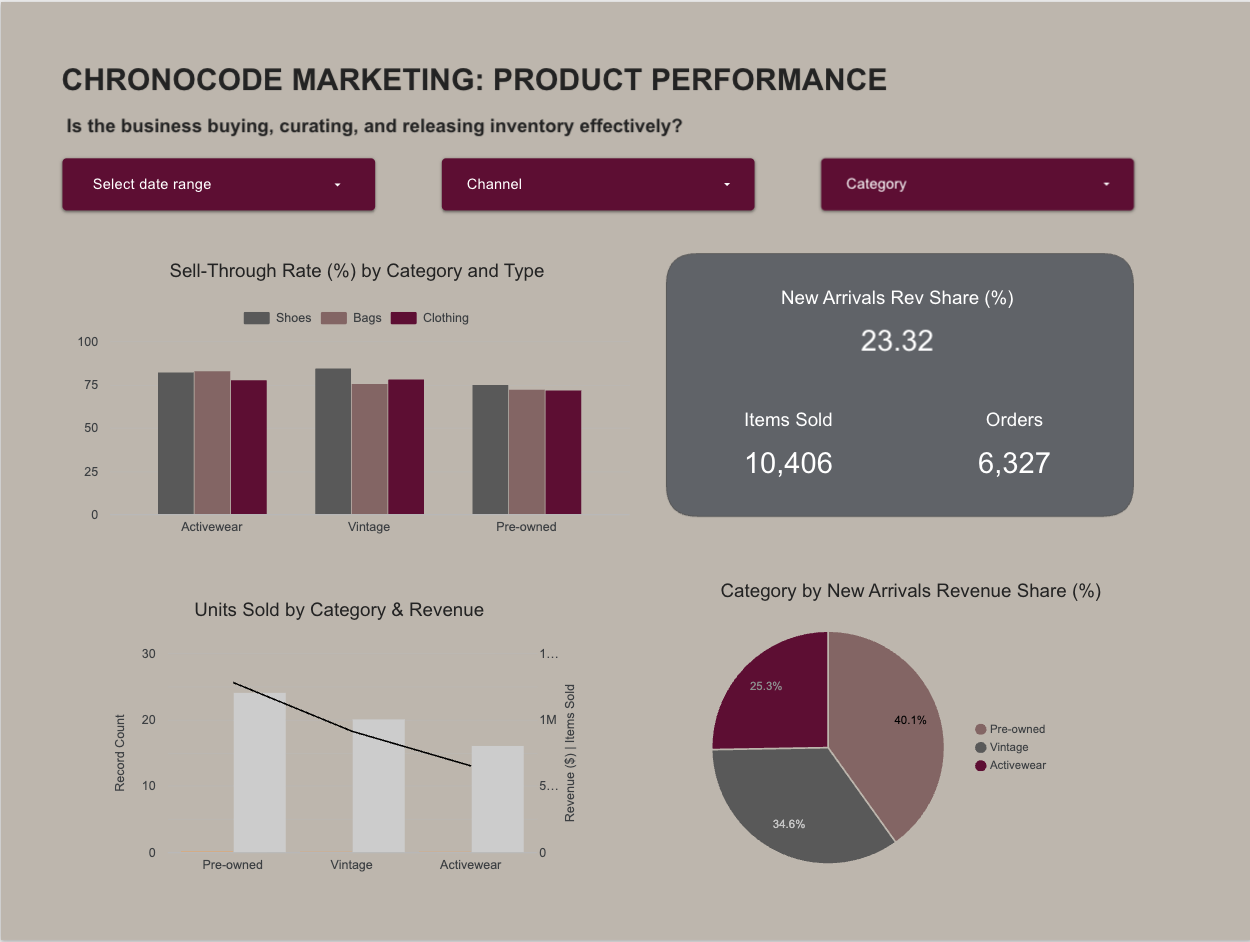
Google Looker dashboards were elevated from static reporting to a structured performance view, aligning KPIs with the original marketing goals. Zapier was selectively used to connect CRM triggers with AI-assisted content generation and reporting workflows, ensuring the system remained comprehensible, maintainable, and appropriate to the scale of the business.
Tech Stack
Results
The marketing automation design delivered a structured, scalable system capable of executing the original fashion resale marketing strategy with greater consistency and measurability. By integrating CRM, inbound workflows, and analytics, the solution enabled more reliable customer engagement, improved visibility into performance drivers, and clearer feedback loops for optimisation. While the project focused on design and configuration rather than live deployment, the intended outcomes include improved email engagement, stronger repeat purchase behaviour, and reduced manual marketing effort. Operationally, the system supports more disciplined marketing execution, allowing the business to grow product range and audience without proportional increases in administrative overhead. The solution represents a design-led implementation rather than a fully deployed production system. Live integrations, real customer data, and long-term performance validation were outside scope. Platform-specific constraints may also affect scalability without paid CRM tiers.
CRM

The CRM was configured to reflect the bespoke requirements of a fashion resale business rather than a generic ecommerce model. Custom fields supported lifecycle stage, repeat buyer status, and campaign attribution, enabling targeted automation. This configuration addressed the 2024 finding that customer retention required more nuanced tracking than basic order history.
Inbound Marketing

Inbound workflows were designed to execute the content and email strategies outlined in 2024 with greater consistency. Automated welcome sequences, product highlights, and re-engagement campaigns replaced ad-hoc communications, ensuring timely and relevant outreach aligned with customer behaviour.
Dashboard

The dashboard consolidated performance metrics across sales, engagement, and retention into a single monitoring view. This directly addressed the 2024 recommendation for regular, data-driven review, enabling ongoing optimisation rather than retrospective reporting.
Limitations

The solution represents a design-led implementation rather than a fully deployed production system. Live integrations, real customer data, and long-term performance validation were outside scope. Platform-specific constraints may also affect scalability without paid CRM tiers.
Future Directions

Future development could focus on progressively enriching customer and campaign data to enable more granular segmentation and lifecycle targeting, while introducing controlled feedback loops between campaign performance and content optimisation. Over time, additional automation could be layered onto the existing architecture to support predictive insights and continuous improvement without altering the underlying system design.
Summary
This case study documents the evolution of the fashion resale marketing program from a manually planned, channel-based strategy in 2024 into a structured, automation-ready marketing system in 2025. The 2024 project established foundational marketing objectives, channel priorities, and performance metrics for a growing vintage luxury reseller, with a strong emphasis on personalisation, storytelling, and data-driven decision-making. Building directly on this groundwork, the 2025 project focused on operationalising those intentions through marketing automation, integrating CRM configuration, inbound campaign design, and analytics into a cohesive system. Rather than expanding channel scope, the emphasis shifted to systemisation, repeatability, and measurement.
The resulting solution demonstrates how a small fashion resale business can transition from strategic intent to scalable execution, using automation and analytics to support long-term growth while preserving the brand’s luxury positioning. A key lesson was the importance of grounding automation decisions in existing strategy. Automation is most effective when it operationalises clear objectives, rather than redefining them. Additionally, formalising data and knowledge structures early reduces downstream complexity and preserves brand integrity as systems scale. Future development of the fashion resale marketing automation could focus on progressively increasing system intelligence rather than expanding channel scope. Over time, AI-assisted content optimisation and recommendation logic could be layered onto existing workflows to personalise messaging at scale while preserving brand tone. Governance and analytics could also be strengthened through interaction logging, cohort analysis, and longitudinal performance tracking, positioning the marketing system as a continuously learning asset that supports strategic decision-making as the business grows.
Bibliography
Adobe (2024). AI marketing. Adobe Business, Blog, 22 July 2024.
Forbes (2025). How generative AI can cut costs and boost creativity for fashion brands. Forbes Finance Council, 14 May 2025.
Klaviyo (2024). State of the ecommerce industry. Klaviyo, September 2024.
McKinsey (2023). Generative AI: Unlocking the future of fashion. McKinsey & Company, 8 March 2023.
Oracle (2024). How AI is reshaping fashion. Oracle Australia, Industries, Retail, 18 June 2024.
Salesforce (2023). AI marketing automation. Salesforce Blog, 13 December 2023.
Shopify (2025). AI marketing. Shopify Blog, 12 May 2025.
Related Projects

Drone Photography Marketing Automation

Real Estate Marketing Automation