
Overview
Business: Commercial drone photography service in Sydney
Size/structure: 18 employees
Goal: Improve marketing performance with current technologies
Solution: Integrated AI across CRM, inbound marketing, and dashboard.
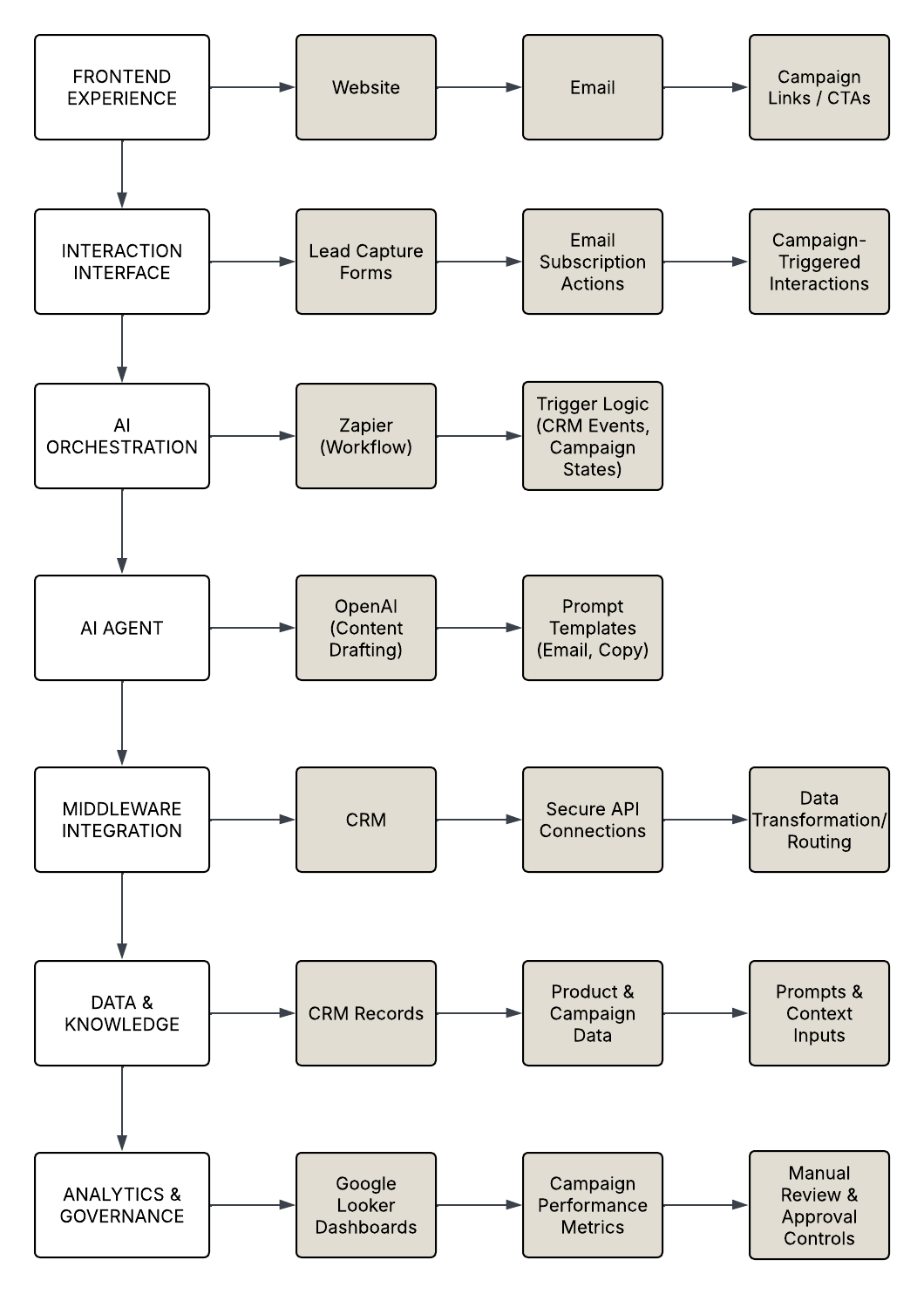
Stack: OpenAI Assistant API, HubSpot, Google Looker Studio, and Zapier.
This project builds on a 2024 marketing program for a drone photography service, where the client seeks to improve recording and management of its customer data, increase brand awareness through search, automate a basic marketing program, and to have more visibility and control over its growing marketing program through cloud data visualisation tools such as a dashboard.
Analysis
Challenge
This 2025 marketing automation project extends the 2024 drone photography marketing program from a manually coordinated, insight-led campaign into a partially automated, systematised marketing operation with in-depth analytics. In 2024, foundational work focused on clarifying target segments, establishing performance metrics, and creating a live analytics dashboard to monitor awareness, engagement, and lead generation. While effective for diagnosis and reporting, this approach relied heavily on manual execution and interpretation and offered limited insight into ongoing performance.
Marketing Objectives

Strategy
Across articles and reports from Adobe (2024), Harvard University (2025), Salesforce (2023), Shopify (2025), and the Digital Marketing Institute (2024), several consistent principles emerge for effective AI marketing automation. First, data quality and structure are foundational: AI systems are only as effective as the CRM, analytics, and event data they ingest, and organisations are advised to prioritise clean customer records, defined lead states, and measurable KPIs before scaling automation. Second, automation should focus on high-frequency, low-judgement tasks such as lead qualification, follow-up messaging, and performance reporting while augmenting, rather than replacing, human judgement in creative direction and client relationships. Third, personalisation is no longer optional - research and observation by McKinsey (2025) and HubSpot (2025) show that customers increasingly expect tailored communication, and AI-driven personalisation materially improves conversion and retention when grounded in observable behaviour rather than demographic assumptions. Finally, best practice emphasises incremental implementation, starting with a small number of automations, validating impact, and then expanding across channels as confidence and data maturity increase. These principles directly informed the design of the 2025 AI marketing automation solution for the commercial drone photography case study.
Solution Design
In 2025, the project evolved to introduce AI-assisted automation across CRM, inbound marketing, and detailed analytics, extending the analytical approach established earlier. The objective was controlled rather than comprehensive automation and augmentation, effectively reducing manual overhead, increasing consistency in follow-up and messaging, and improving data visibility to support iterative optimisation. This phase positions the business for scalable growth without sacrificing the bespoke, high-quality service positioning critical in a mature, competitive commercial drone photography market.
AI Automation
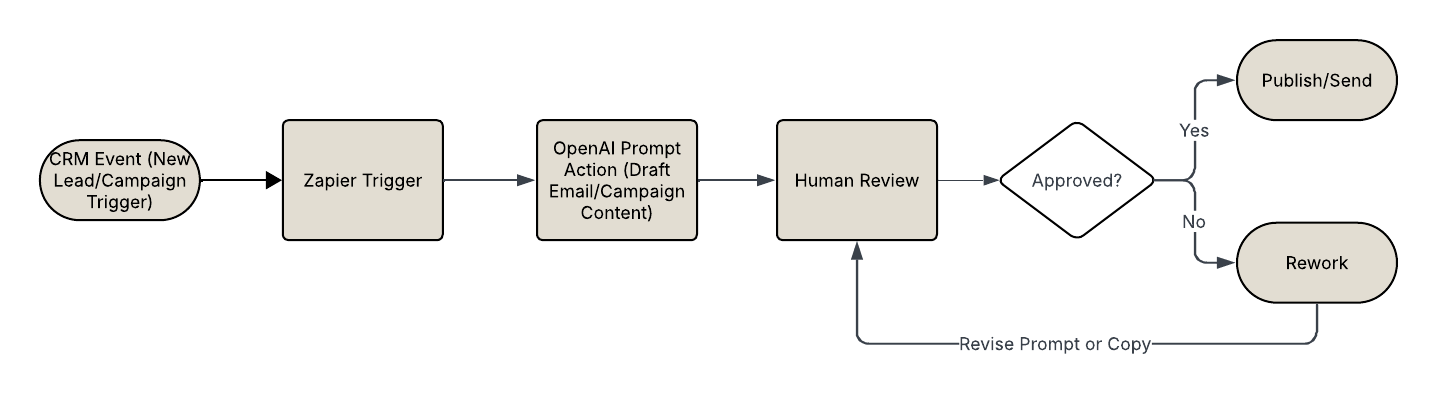
The 2025 solution integrated a limited layer of AI-assisted marketing automation using OpenAI exclusively through single-step Zapier actions, rather than a persistent assistant or agent architecture. Automation was applied to narrowly defined tasks where consistency and speed were critical, most notably the generation of personalised first-touch communications triggered by new lead creation in HubSpot CRM. OpenAI prompts were designed to be stateless and deterministic, inserting CRM fields into pre-defined templates aligned with the brand voice and service positioning established in 2024. This approach reduced response latency and manual drafting effort while deliberately avoiding conversational memory, autonomous decision-making, or multi-step orchestration, ensuring the automation remained appropriate to the scale, risk profile, and relationship-driven nature of a commercial drone photography business.
Automation Flow Diagram
Data Preparation
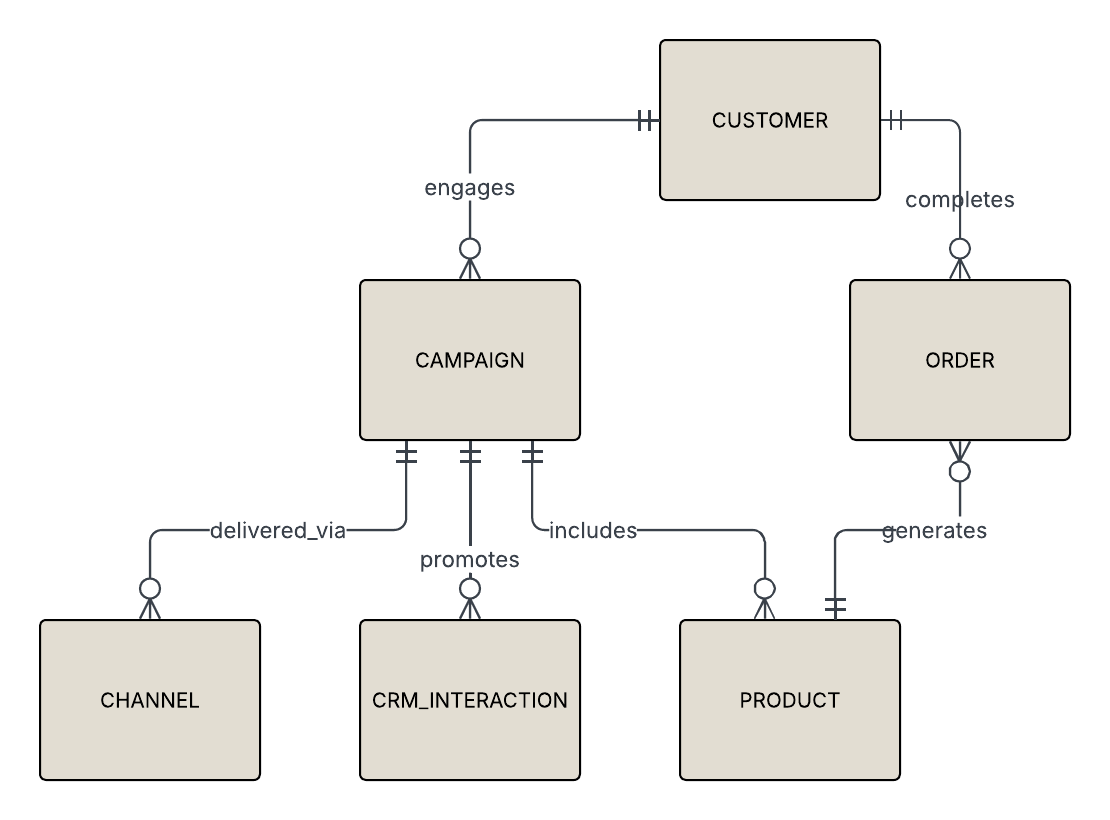
To enable this, core marketing data was formalised through a lightweight CRM configuration aligned with the lead stages, channels, and performance metrics already defined in 2024. The inbound marketing workflows and dashboard were refined to share a common structure, ensuring that captured data could flow coherently from lead acquisition through to reporting. While limited in scale, this formalisation established clearer data ownership and traceability, providing a practical foundation for future marketing optimisation and broader business decision-making.
Data Model
CRM, Inbound Marketing, and Dashboard.
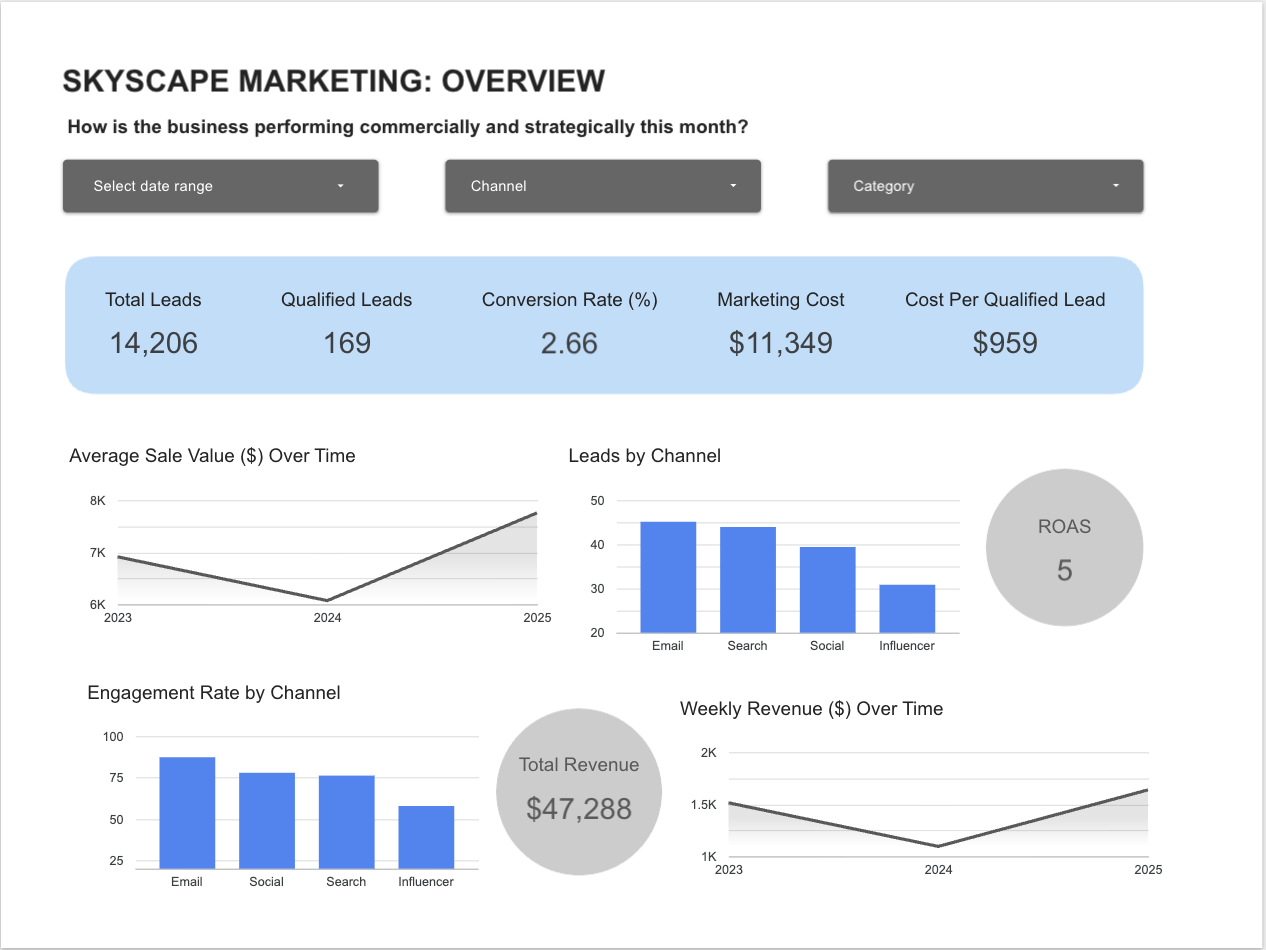
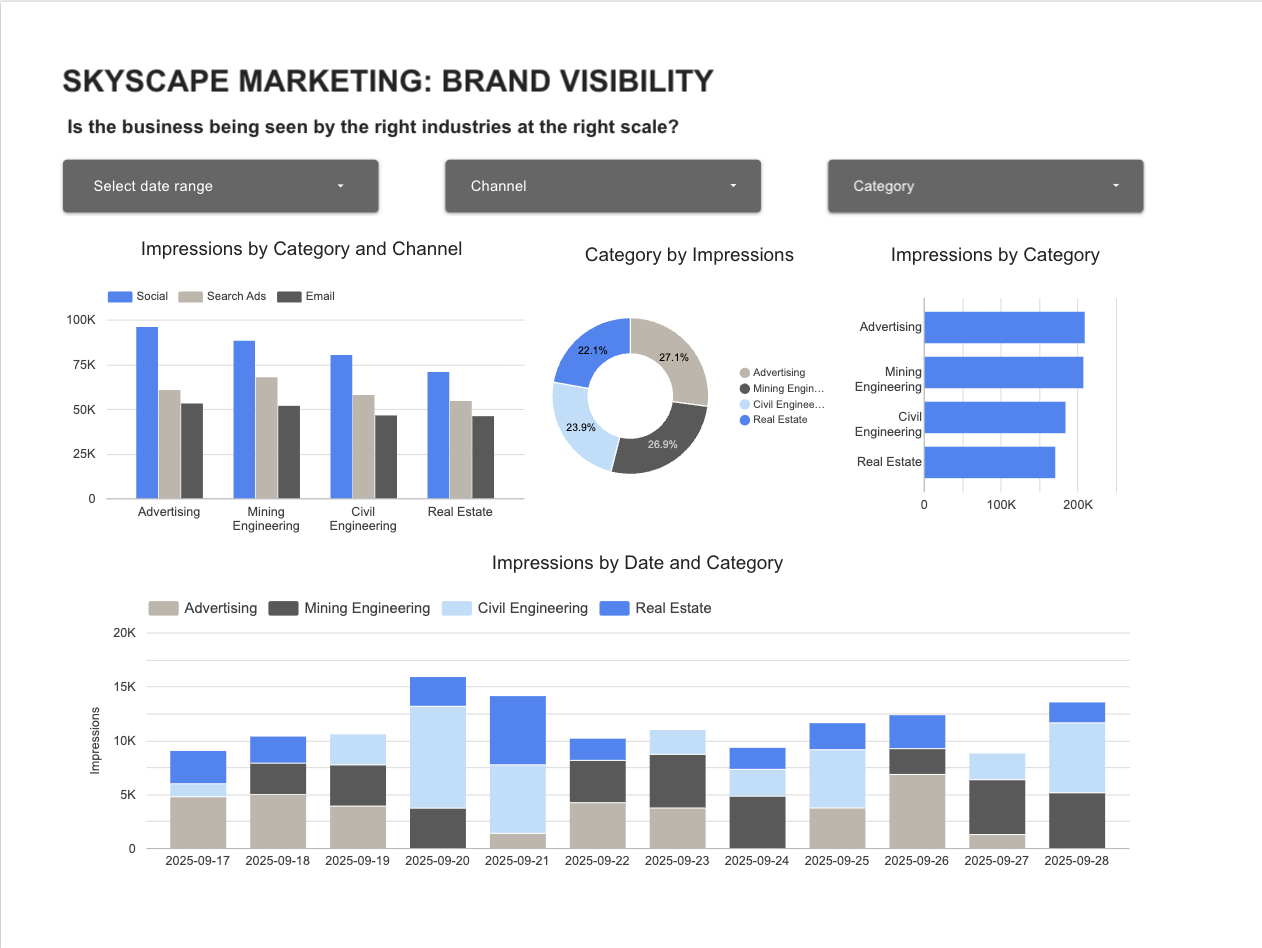
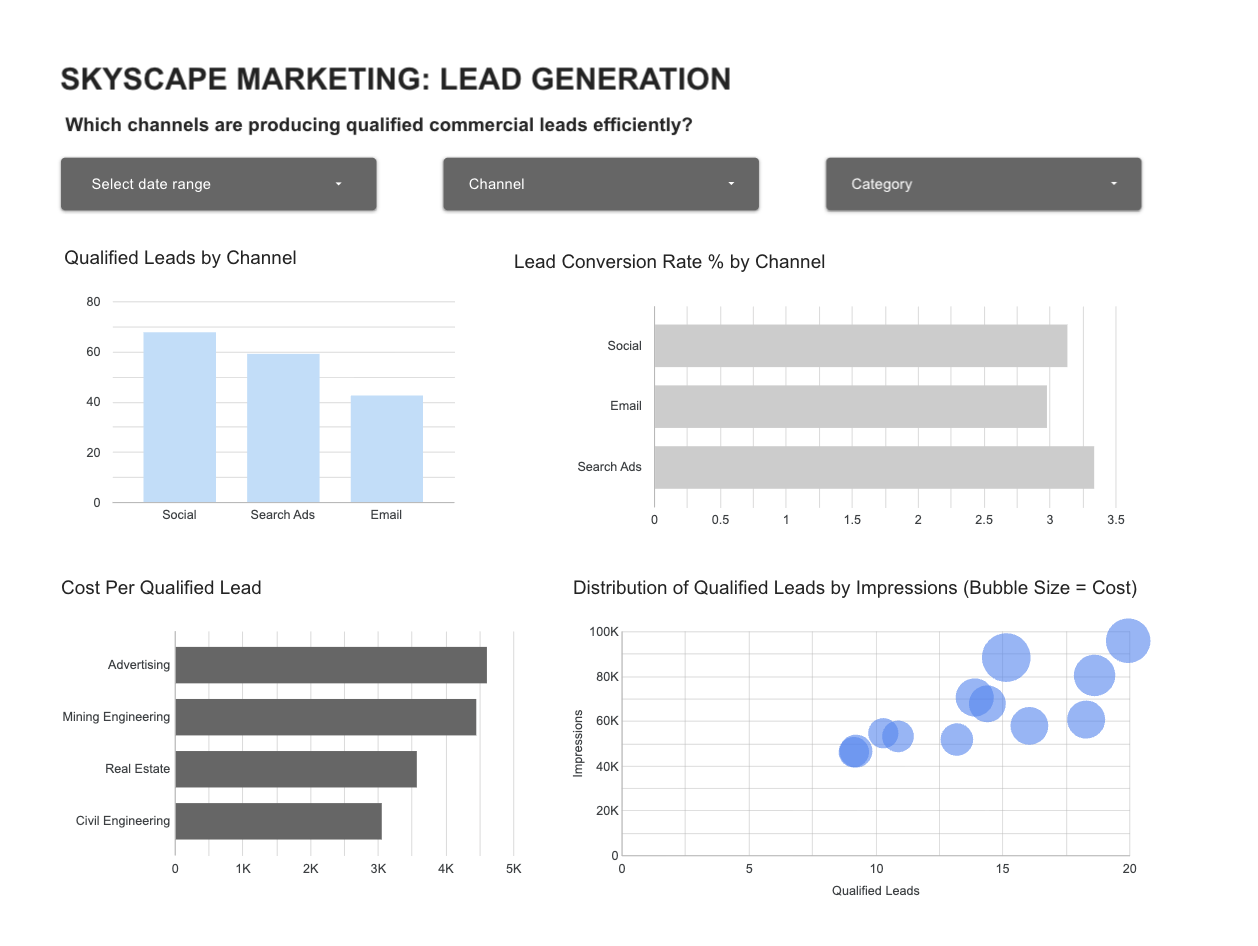
The CRM, inbound marketing workflows, and dashboard were each configured to reflect the operating realities of a B2B commercial drone photography service competing in a mature, visually driven market. HubSpot CRM was used to formalise lead capture and progression for enquiries originating from search, social, and website forms, with properties tailored to distinguish industry segments such as property, construction, and events. Zapier automation was applied narrowly to trigger timely, personalised first-touch communications using AI-assisted drafting, ensuring responsiveness without over-automating relationship management. The Google Looker dashboard was designed to surface awareness, engagement, and lead-quality signals aligned to the original objectives, enabling the business to monitor which channels and content types generated commercially viable enquiries. Together, these elements operationalised the marketing objectives by balancing automation, data visibility, and manual judgement appropriate to the business context.
Tech Stack
Results
The 2025 design delivers operational efficiency gains without altering the business’s external value proposition. Automated lead handling reduces response latency and ensures consistent initial engagement, while the preserved dashboard enables ongoing evaluation of campaign effectiveness. By retaining manual control over high-value interactions, the business avoids the risks of over-automation while benefiting from reduced administrative burden. The intended outcome is a more resilient marketing operation capable of handling fluctuating demand with minimal additional effort. Importantly, the project establishes a scalable framework rather than a fixed implementation, allowing future expansion into more advanced automation or AI-driven optimisation as data maturity increases.
CRM

The CRM was configured to reflect the lead categories and lifecycle stages identified in 2024. Custom fields aligned with dashboard dimensions, ensuring continuity between operational activity and reporting.
Inbound Marketing

Inbound workflows were tailored to prioritise high-intent B2B enquiries, automating initial responses while deferring complex interactions to manual follow-up.
Dashboard

The existing dashboard was retained but enhanced as a control surface, allowing performance monitoring to directly inform automation tuning rather than retrospective analysis.

Limitations
The solution remains partially manual by design, limiting the immediate efficiency gains achievable through full automation. Data volumes also constrain the sophistication of AI-driven optimisation at this stage.
Future Directions

Possible future directions include migrating from single-step Zapier-based text generation to a managed AI assistant capable of maintaining context across multiple touchpoints, and progressively enriching CRM and campaign data to support more advanced segmentation, performance analytics, and adaptive marketing workflows as data volume and operational maturity increase.
Summary
This case study demonstrates a deliberate progression from insight-driven marketing in 2024 to execution-supported automation in 2025. Rather than replacing the earlier work, the marketing automation layer formalises and operationalises it, preserving analytical rigor while improving efficiency. The result is a cohesive system that balances personal service with scalable processes. The solution remains partially manual by design, limiting the immediate efficiency gains achievable through full automation. Data volumes also constrain the sophistication of AI-driven optimisation at this stage. Key lessons include the importance of aligning automation with existing data models, resisting unnecessary tool sprawl, and treating dashboards as active control mechanisms rather than passive reports.
Bibliography
Adobe (2024a). State of marketing automation. Adobe Business, August 2024.
Adobe (2024b). AI marketing. Adobe Business, Blog, 22 July 2024.
Digital Marketing Institute (2024). Examples of AI in marketing automation. Digital Marketing Institute, 23 December 2024.
Harvard University (2025). AI will shape the future of marketing. Harvard University Professional & Executive Development, Division of Continuing Education, 14 April 2025.
HubSpot (2023). AI marketing automation - What marketers need to know. HubSpot Blog, 23 May 2023.
McKinsey (2025). Seizing the agentic AI advantage. Sukharevsky, A., Kerr, D., Hjartar, K., Hamalainen, L., Bout, S., Di Leo, V., and Dagorret, G. writing for QuantumBlack, AI by McKinsey, 13 June 2025.
Salesforce (2023). AI marketing automation. Salesforce Blog, 13 December 2023.
Shopify (2025). AI marketing. Shopify Blog, 12 May 2025.
Related Projects

Real Estate Marketing Automation
Fashion Resale Marketing Automation