
Overview
Client: Dance fitness studio
Business size: 20 employees
Goal: Revamping website, showcasing new classes, integrating AI.
Solution: Ecommerce store
Stack: Shopify, OpenAI, Zapier, Google Sheets, Gmail.
This 2025 project integrates AI into the 2024 Shopify dance studio by introducing a unified, conversational layer for class discovery, enquiries, and bookings. Rather than replacing the existing site structure, the assistant augments the original data model, information architecture, and brand tone with natural language interaction. This evolution reduces fragmentation across tools, supports progressive commitment, and enables more personalised, low-friction engagement while preserving the clarity and instructional quality established in the original studio experience.
Analysis
The 2024 dance studio Shopify site successfully communicated class offerings and membership options but relied on multiple, disconnected interaction tools for enquiries, discovery, and bookings. This fragmentation increased cognitive load, required users to navigate between interfaces, and limited the studio’s ability to provide personalised guidance without manual intervention. As user expectations shifted toward conversational, on-demand assistance, the existing model constrained scalability and responsiveness. The 2025 challenge was therefore to unify these interactions into a coherent experience that reduced friction, preserved user agency, and leveraged the studio’s existing structured data and content without disrupting the established Shopify design.
Objectives
Reduce friction between class discovery, enquiry, and booking
Improve personalisation without increasing operational overhead
Replace siloed third-party tools with a unified conversational layer
Preserve the clarity and structure established in the 2024 Shopify design
Enable scalable experimentation with AI-assisted customer interaction
User Personas

“As a first-time class member, I want to use a quiz on the website to help me quickly find a beginner-friendly dance class by matching my interests and availability, so I can make an easy decision without feeling overwhelmed.”

“As a ballet dancer until my teens wanting to reconnect with dance now that my children are grown up, I want a chatbot on the website so that I can ask it specific questions about finding the right class for me.”

“As a member of a modern dance group until my twenties wanting to get back into dance for fun, I want to see recommendations on the site so that I can quickly find an interesting new class that I might not have considered before.”
Strategy
The 2025 strategy draws directly from McKinsey (2024), Accenture (2024), LlamaIndex (2024), Salesforce (2025), Shopify (2025), Les Mills (2025), and Genesys (2025), which emphasise experiential engagement, progressive commitment, and minimising barriers to participation, supported by research on service personalisation and digital self-service. Industry guidance from McKinsey (2024) and Accenture (2024) highlight growing user expectations for immediate, tailored responses and conversational access to services, while Shopify (2025) research underscores the importance of integrated journeys over channel-specific optimisation. Three relevant benchmarks inform the design rationale: conversational booking flows in ClassPass-style platforms, AI-assisted onboarding used in boutique fitness apps, and context-aware service chat in hospitality. Translating these principles to the dance studio context, the AI assistant was designed to guide users incrementally, from curiosity to confidence to commitment, using natural language to surface relevant classes, answer nuanced questions, and facilitate bookings without forcing users into rigid flows or multiple interfaces.
Solution Design
AI Assistant Scope & Role
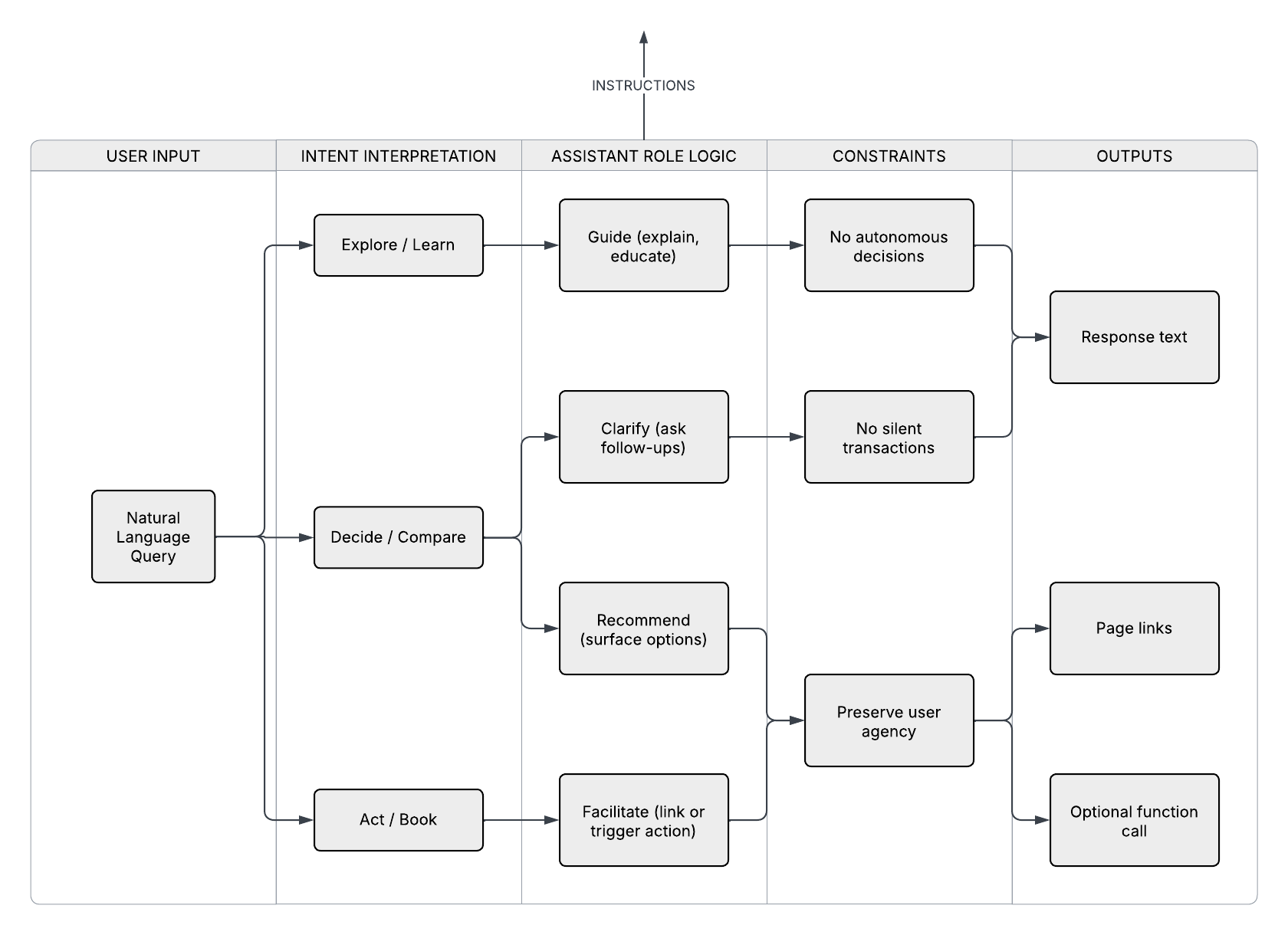
The 2025 AI assistant was scoped as an assistive, non-autonomous layer that consolidates class discovery, enquiry handling, and bookings into a single conversational interface. Consistent with the 2024 dance studio design approach, the assistant does not replace existing navigation or transactional patterns but augments them by reducing context-switching between pages and third-party tools. Its role is to interpret user intent expressed in natural language, translate that intent into structured queries against existing class and membership data, and guide users toward appropriate next steps. This mirrors the 2024 emphasis on progressive commitment, enabling casual exploration before prompting action. By positioning the assistant as a guide rather than a decision-maker, the design preserves user agency and aligns with the studio’s supportive, instructional brand tone.
Instruction Logic
Data & Knowledge Preparation
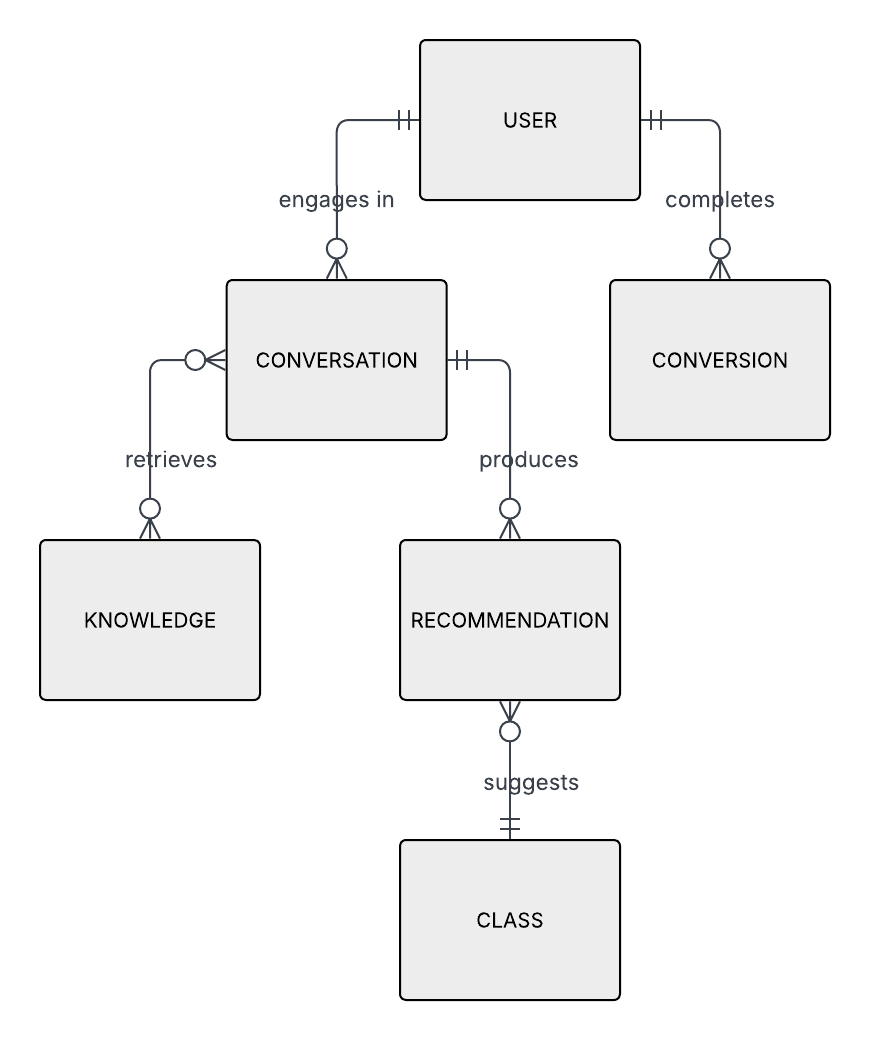
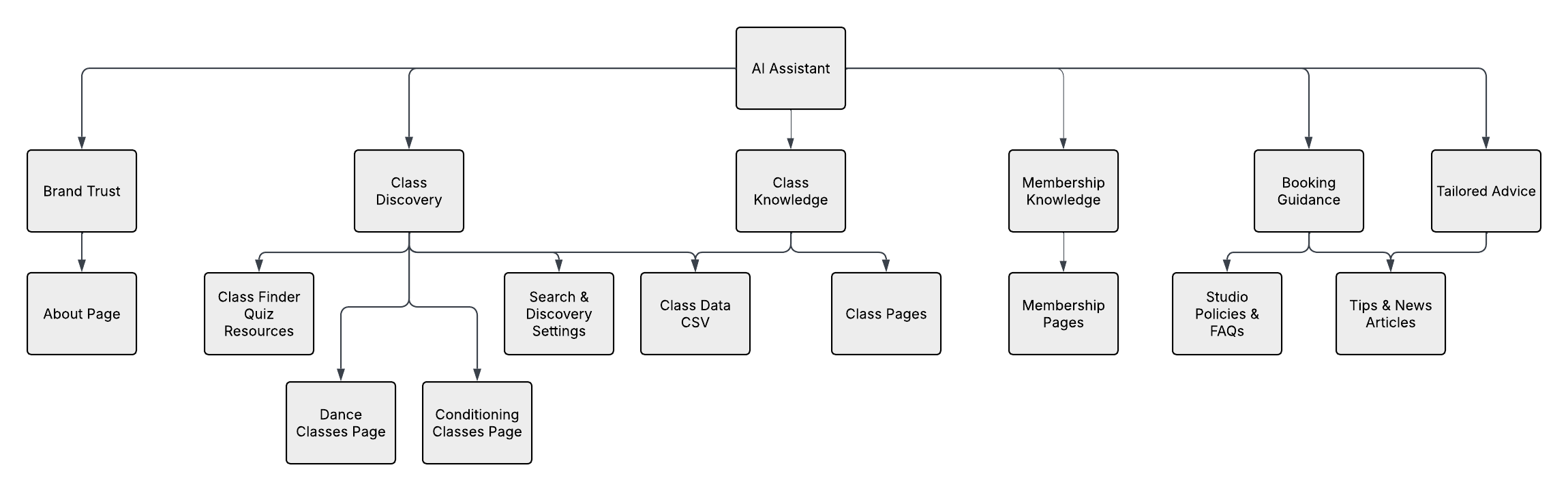
Data preparation builds directly on the structured class taxonomy established in 2024, where classes, schedules, instructors, and memberships were already clearly defined entities. For 2025, this data was reformatted to support retrieval-augmented conversational access, ensuring consistent attribute naming and semantic clarity across class type, intensity, duration, and suitability. In parallel, knowledge content derived from FAQs, policies, and participation guidance was formalised into discrete knowledge domains. This preparation enables the assistant to answer nuanced questions while remaining grounded in the same authoritative content previously accessed via static pages. The approach reinforces a key lesson from the 2024 project: disciplined data and content structure are prerequisites for reliable AI-assisted interaction.
Data Model
Knowledge Structure
Interaction Design
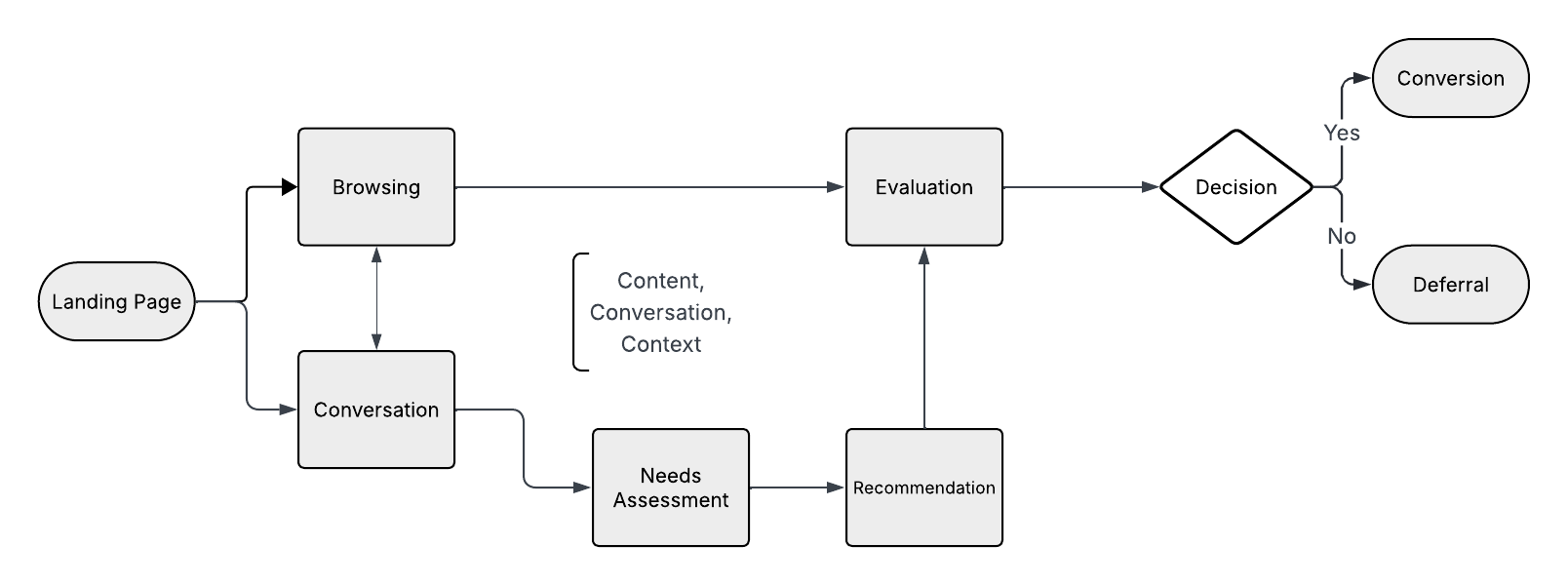
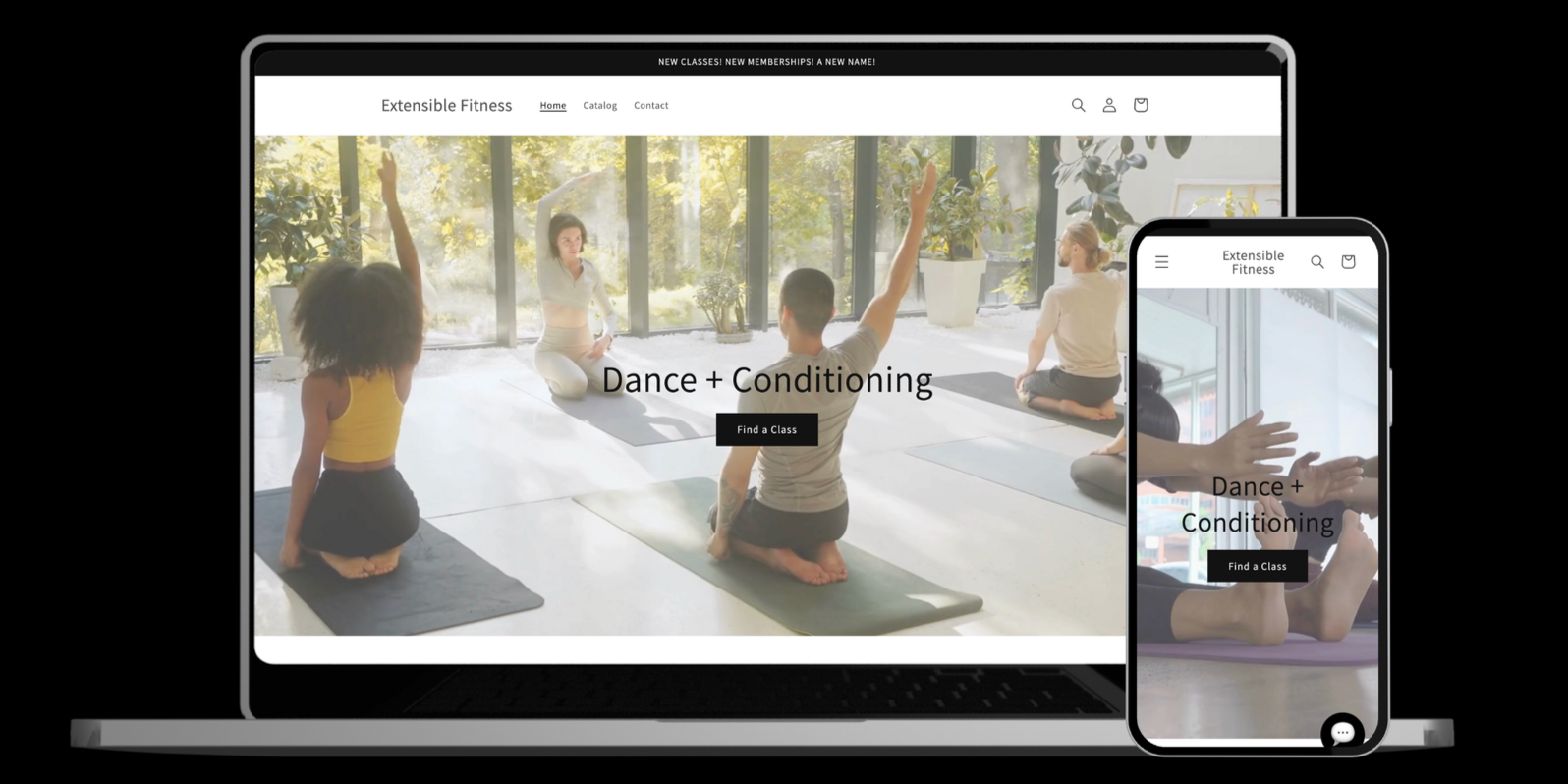
Interaction design replaces the fragmented 2024 chat, FAQ, and booking flows with a unified conversational model while retaining the original site’s visual hierarchy. The assistant supports both exploratory dialogue and structured guidance, dynamically shifting between free-form responses and clarifying prompts as user intent becomes more explicit. This effectively subsumes the earlier quiz-based discovery into a more adaptive interaction without increasing cognitive load. The assistant remains persistently accessible across the site, maintaining conversational context as users browse. Importantly, interaction design was constrained to complement, not dominate, the existing UI, reflecting the 2024 design principle that guidance should be available but never intrusive. This balance ensures continuity for users who prefer traditional navigation.
Information Architecture
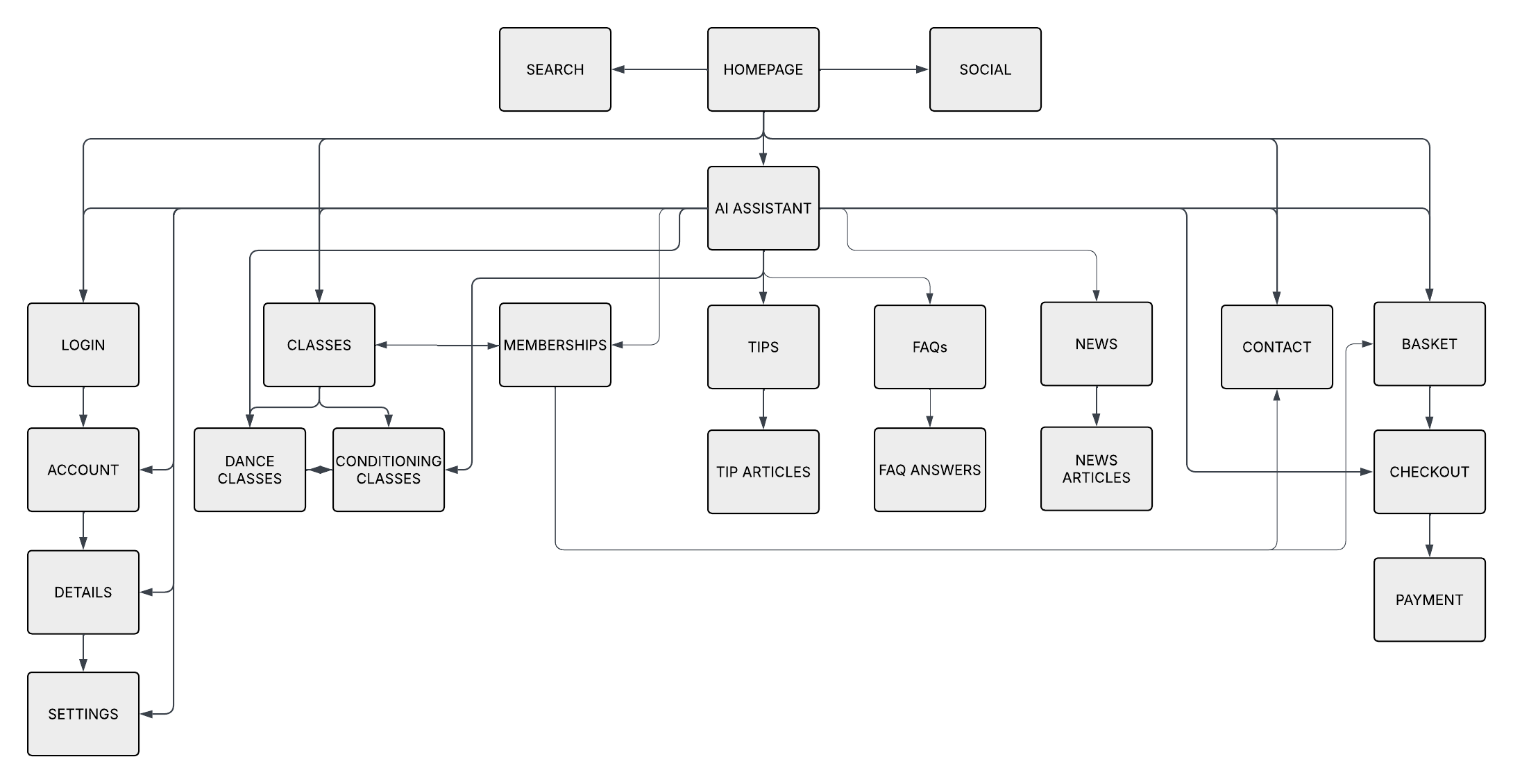
User Flow
Technical Integration
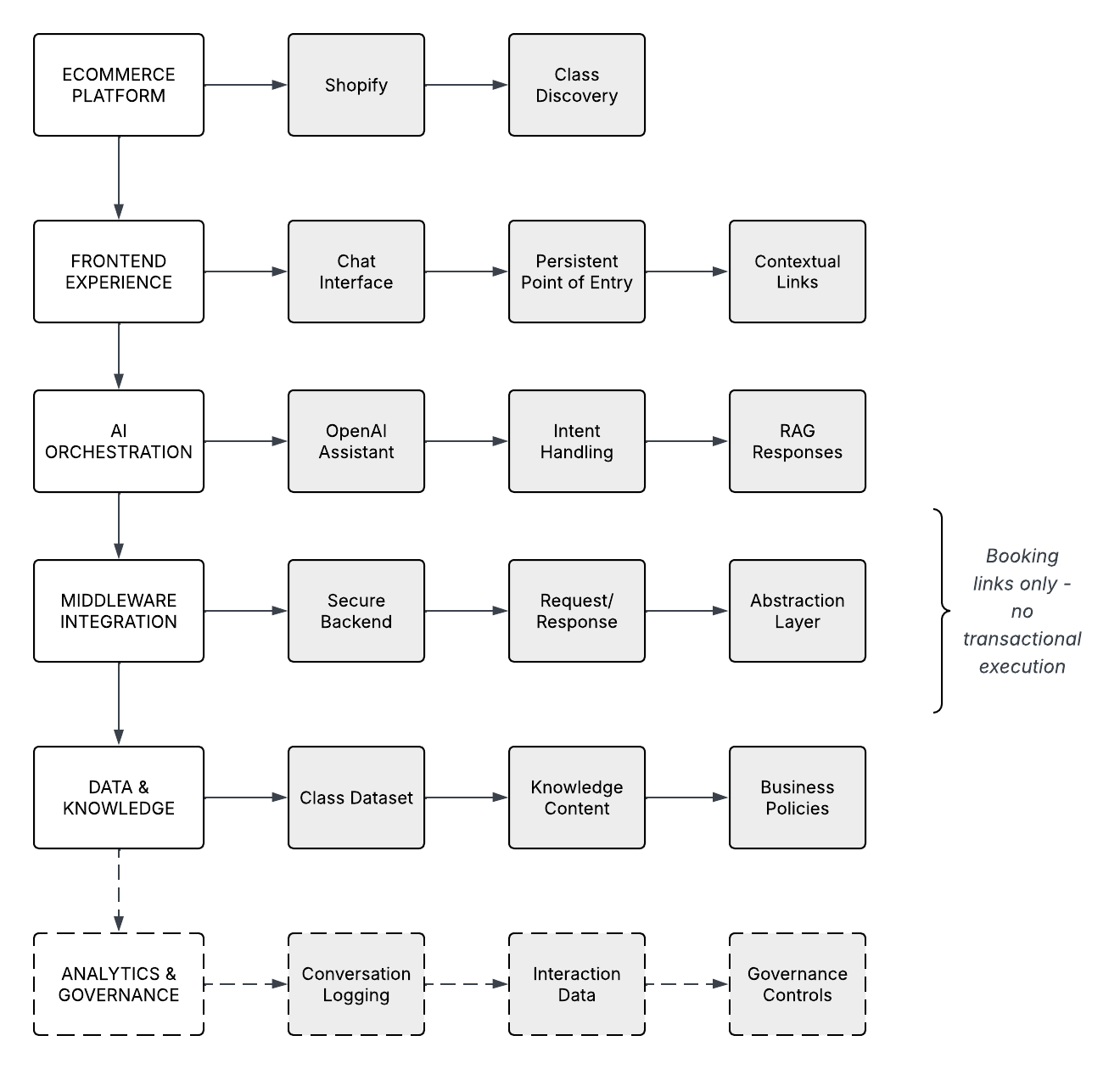
Technically, the assistant is integrated via a secure middleware layer separating the Shopify frontend from the AI API, consistent with the 2025 AI integration methodology. This architecture protects credentials, enables future analytics and logging, and supports extensibility without modifying core storefront logic. Function calls for bookings are invoked only when conversational intent is clear, preventing premature automation.
The assistant consumes prepared data and knowledge files rather than scraping live pages, ensuring response stability and alignment with approved content. This integration strategy reflects a deliberate evolution from the 2024 reliance on multiple third-party widgets toward a cohesive, maintainable system that remains production-oriented rather than experimental.
Tech Stack

Results
The 2025 redesign improves the overall user experience by reducing fragmentation and supporting more natural, personalised interaction. Users are no longer required to navigate multiple tools or pages to achieve their goals, resulting in a smoother journey from interest to commitment. The assistant enhances clarity, responsiveness, and confidence, particularly for new users unfamiliar with class formats or studio culture. Importantly, these gains are achieved without sacrificing the structured, content-rich foundation established in 2024.
Use Case 1: First-time Class Member

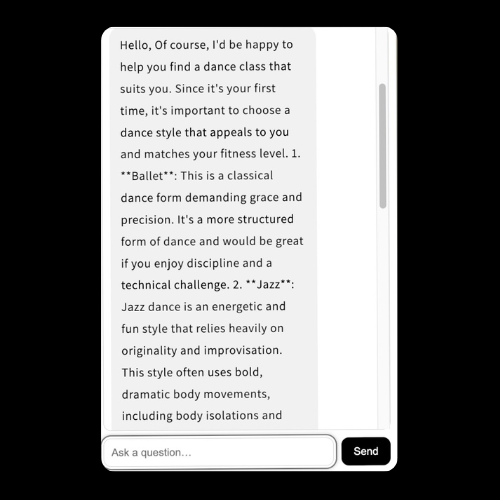
For a first-time visitor exploring dance classes, the assistant provides an approachable entry point by answering broad questions and offering gentle guidance without overwhelming detail. By referencing class types, difficulty levels, and studio ethos conversationally, the design lowers the psychological barrier to participation. This directly builds on the 2024 emphasis on inclusivity while addressing observed friction in static navigation paths.
Use Case 2: Experienced Class Member

Returning members seeking schedule or booking information benefit from immediate, context-aware responses. The assistant reduces time-to-action by bypassing navigation steps, reflecting the efficiency goals identified in the original Shopify design while improving responsiveness through AI-driven interaction.
Use Case 3: Expert Class Member

Prospective members comparing options receive personalised explanations of memberships and class combinations. This supports informed decision-making and reflects the studio’s educational, supportive tone, reinforcing trust and long-term engagement.
Limitations

Despite its benefits, the 2025 design has limitations. First, the absence of full conversation logging restricts the studio’s ability to analyse user behaviour and iteratively refine assistant performance. Second, the assistant relies on the accuracy and completeness of existing data; gaps or inconsistencies in class information can directly affect response quality. Third, while conversational interaction improves flexibility, some users may still prefer explicit visual navigation, requiring careful balance to avoid over-reliance on AI. These limitations underscore shared constraints in early-stage AI ecommerce implementations.
Future Directions

Future iterations of the dance studio AI assistant could focus on deeper personalisation and evaluation through secure conversation logging and analytics, enabling evidence-based refinement of responses and flows. Additional integrations may include member profile memory to support repeat interactions, adaptive class recommendations based on attendance patterns, and expanded booking automation across workshops or events. As data maturity and governance improve, the assistant could gradually adopt more agentic behaviours while remaining aligned with the studio’s instructional, human-centred ethos and the structured foundations established in the 2024 and 2025 designs.
Summary
The 2025 dance studio project represents a considered evolution of the 2024 Shopify product design, transforming structured content and navigation into a cohesive, conversational experience. By preserving the original data model, information architecture, and brand tone, the project demonstrates how AI can enhance rather than disrupt established design foundations. Key lessons include the importance of data readiness, the value of progressive disclosure in conversational design, and the need to balance automation with user control. The case study illustrates a pragmatic approach to AI integration, positioning the assistant as an adaptive layer that amplifies existing strengths while creating a scalable pathway for future refinement and analytics-driven improvement.
Bibliography
Accenture (2024). Reinventing consumer experiences. El-Warraky, N. writing for Accenture, Blog, 15 November 2024.
Genesys (2025). AI for the experience economy: How to deliver the next level of experience. Genesys, Blog, 7 July 2025.
Les Mills (2025). Beyond ChatGPT: How clubs can attract high-value members with AI. Jak Phillips, Les Mills Asia Pacific, April 2025.
LlamaIndex (2024). Case study: GymNation revolutionizes fitness with AI agents powering member experiences. LlamaIndex, 29 August 2024.
McKinsey (2024). What is the future of wellness? McKinsey, 20 November 2024.
Salesforce (2025). Equinox gives clients a personal AI fitness concierge with Agentforce. Salesforce, 5 May 2025.
Shopify (2025). AI in ecommerce 2025: 7 use cases and a complete guide. Shopify, 27 June 2025.